


Table of Contents
Introduction: Why This Conversation Matters
What AI Vendors Promise
The Reality of Outdoor Security Operations
Where AI Detection Performs Well
Where AI Detection Falls Short
Humans vs. AI: A Practical Comparison
The Cost of Over-Trusting AI
The Hybrid Model That Actually Works
Conclusion: Reframing AI’s Role in Security
Frequently Asked Questions (FAQ)
1. Introduction: Why This Conversation Matters
Artificial intelligence has become one of the most heavily marketed technologies in the security industry. Brochures promise “24/7 protection,” “fewer false alarms,” and “rapid response times.” For organizations under pressure to reduce costs and modernize quickly, these claims are compelling.
But in real outdoor security operations—construction sites, utilities, perimeters, industrial yards—the gap between AI marketing claims and operational reality remains significant.
At Jatagan Security, we’ve seen firsthand that while AI detection is a powerful tool, it is not a replacement for human judgment. Understanding where AI helps—and where it fails—is essential to building security systems that actually work.
2. What AI Vendors Promise
Most AI security platforms market variations of the same core claims:
Continuous, fatigue-free monitoring
Human-level or superior detection accuracy
Fewer false alarms
Faster response times
Reduced reliance on live guards
Scalable protection across large sites
On paper, this suggests a future where cameras “watch themselves” and incidents are stopped automatically.
The reality is more nuanced.
3. The Reality of Outdoor Security Operations
Based on Jatagan’s internal data, AI-only detection systems using professional-grade equipment are typically 70–85% effective in real-world outdoor environments.
Outdoor environments are unpredictable by nature. Unlike controlled indoor spaces, they introduce constant variability:
Changing light throughout the day
Weather conditions like rain, fog, snow, and dust
Vegetation movement
Animals, insects, and debris
Obstructions like fences, equipment, and glare
AI models depend on patterns learned from historical data. Outdoor environments constantly violate those patterns.
Humans, by contrast, rely on contextual reasoning and intuition developed through experience. They adapt instantly to new conditions without retraining or reconfiguration.
4. Where AI Detection Performs Well
To be clear: AI detection is not ineffective. When deployed correctly, it delivers real value.
AI excels at:
Monitoring large numbers of cameras simultaneously
Detecting obvious motion or presence
Enforcing virtual tripwires and zones
Flagging routine intrusions quickly
Reducing the burden of continuous human observation
AI is especially effective as a first-line filter—narrowing thousands of hours of video down to moments that deserve attention.
5. Where AI Detection Falls Short
Despite marketing claims, AI still struggles in several critical areas.
Lack of Context
AI can identify objects, not intentions. It cannot reliably distinguish:
A worker vs. a thief
A passerby vs. someone casing a site
Normal behavior vs. suspicious behavior
Humans infer intent from subtle cues AI cannot interpret.
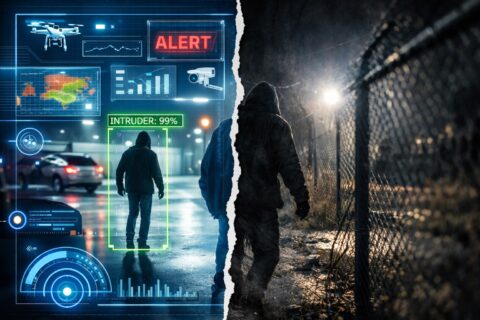
Below image shows AI’s failure in detecting a human behind the fence:
Fragility in Real Conditions
AI performance degrades with:
Partial visibility
Obstructions
Poor camera angles
Lighting anomalies
A human can still recognize a threat from incomplete information. AI often cannot.
Edge Case Blindness
Security failures rarely happen during “normal” scenarios. They occur during unusual, improvised, or unexpected events—the exact situations AI handles worst.
6. Humans vs. AI: A Practical Comparison
| Capability | AI Detection | Human Monitoring |
|---|---|---|
| Continuous attention | Excellent | Limited |
| Contextual understanding | Weak | Strong |
| Adaptation to novelty | Poor | Strong |
| Performance in bad weather | Inconsistent | Reliable |
| Detection of subtle threats | Limited | Strong |
| Accountability | None | Direct |
| Scalability | High | Low |
This comparison highlights a critical truth: AI and humans solve different problems.
7. The Cost of Over-Trusting AI
The biggest operational risk is not that AI fails—it’s that AI fails silently.
When human monitoring fails, there are visible warning signs:
Fatigue
Understaffing
Missed calls
When AI fails:
No alert is generated
No one is notified
The system appears to be “working”
This creates a dangerous false sense of security. By the time an incident is discovered, the opportunity to respond has already passed.
8. The Hybrid Model That Actually Works
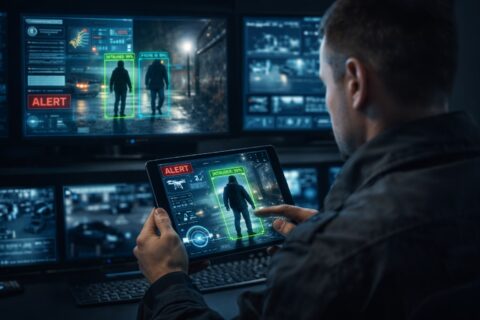
The most effective security deployments do not treat AI as a replacement for humans. They treat it as an amplifier.
In a hybrid model:
AI performs continuous detection and filtering
Humans verify, interpret, and respond
AI reduces noise; humans make decisions
Humans remain accountable
This approach delivers the scalability of AI without sacrificing judgment, context, and adaptability.
At Jatagan Security, this hybrid philosophy underpins how we design and evaluate security systems—especially for high-risk outdoor environments.
9. Conclusion: Reframing AI’s Role in Security
AI is neither a silver bullet nor a gimmick. It is a powerful tool with clear strengths and clear limits.
The problem is not AI itself—it’s how it’s marketed.
When AI is sold as a replacement for human judgment, organizations are set up for failure. When it is positioned as part of a layered, human-centered security strategy, it becomes transformative.
AI should watch more. Humans should decide more.
That is the operational reality.
10. Frequently Asked Questions (FAQ)
Q1: Can AI completely replace live security monitoring?
No. AI lacks contextual reasoning, accountability, and adaptability. It can assist monitoring, but not replace human judgment.
Q2: Does AI reduce false alarms?
Sometimes. Well-trained AI can reduce certain types of noise, but poor tuning or environmental changes can increase false alarms.
Q3: Is AI more cost-effective than human guards?
AI can reduce labor costs at scale, but failures can be far more expensive than staffing savings if incidents are missed.
Q4: How accurate is AI-only video security in outdoor environments?
Based on Jatagan’s internal data, AI-only detection systems using professional-grade equipment are typically 70–85% effective in real-world outdoor environments. Factors such as lighting, weather, obstructions, and partial visibility can significantly reduce AI accuracy.
Q5: Why does AI struggle outdoors more than indoors?
Outdoor environments are dynamic and unpredictable, while most AI models perform best in controlled conditions.
Q6: What is the best use of AI in security today?
As a detection and filtering layer that supports—rather than replaces—human operators.