


Four cameras. Complete 360° coverage. A 150-foot range.
Placed together on a security proposal, those numbers can sound like a complete performance specification. They are not.
Each number answers a different question:
- Four cameras describes the equipment count.
- 360° describes a nominal horizontal field of view.
- 150 feet describes a distance—but not what the system can reliably accomplish at that distance.
Four properly configured camera heads can provide a 360° overview. Commercial multidirectional cameras are designed to do exactly that. But a complete-looking view does not automatically prove reliable AI human detection, behavioral assessment, recognition, or identification at 150 feet—particularly at night.
Verdict: Four cameras can provide nominal 360° coverage. The claim becomes meaningful only when the provider defines the required security outcome, equipment, lighting, analytics, mounting conditions, and validation method.
Table of Contents
- Three Numbers—and Three Different Questions
- Can Four Cameras Provide 360° Coverage?
- What Does “150 Feet” Actually Mean?
- Why Nighttime Performance Changes the Answer
- What Proof Should Support the Claim?
- How Jatagan Evaluates Camera Coverage
- Conclusion
- Frequently Asked Questions
1. Three Numbers—and Three Different Questions
A camera-count and distance claim should be separated into its individual parts.
| Part of the claim | What it tells you | What it does not tell you |
|---|---|---|
| Four cameras | How many camera views or sensors are being used | Resolution, lens, sensor quality, analytics, illumination, or mounting position |
| 360° coverage | The views may collectively surround the mounting point | Whether every direction has useful detail, lighting, overlap, or an unobstructed view |
| 150-foot range | A target may be visible or detectable somewhere within that distance | What security task can be performed, under what conditions, and with what reliability |
The figures are related, but one does not prove the others.
A proposal can be geometrically correct and still be operationally incomplete. The missing information is what the system must accomplish at the stated distance.
4 Cameras. 360°. 150 Feet. What Does It Actually Prove?
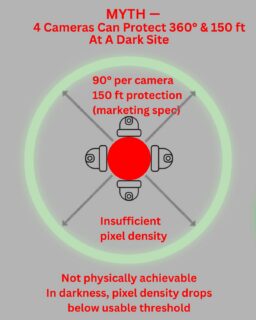
[A coverage claim is not a performance specification.]
2. Can Four Cameras Provide 360° Coverage?
Yes—in the geometric sense.
If four cameras each provide a 90° horizontal view:
4 cameras × 90° = 360°
Commercial multidirectional cameras use independently adjustable camera heads to monitor several directions simultaneously. Some provide up to 360° coverage in four separate video streams, with the viewing angle and zoom of each head set individually.
That makes the four-camera claim physically possible. It does not mean every four-camera layout delivers complete site protection.
The Views May Need to Overlap
Four exact 90° views positioned edge-to-edge leave little tolerance for aiming errors, movement of the mounting structure, or weaker performance near the edges of each image.
Some overlap may be needed to create smoother transitions between adjacent views. Once views overlap, however, their unique combined coverage is less than the simple sum of their advertised angles.
360° Around the Camera Is Not the Same as 360° Across the Site
A system may see in every direction from its mounting point while important areas remain blocked by:
- Buildings
- Containers
- Equipment
- Material stacks
- Fencing or privacy mesh
- Vehicles
- Terrain
The camera configuration may provide a complete ring of visibility and still leave site-level blind spots.
Horizontal Coverage Is Only One Dimension
A 360° figure normally refers to horizontal coverage. It does not explain:
- The vertical field of view
- How much sky or ground occupies the image
- Whether the area directly below the camera is visible
- Whether a high mounting angle obscures activity near walls, vehicles, or containers
- How much useful detail remains at the perimeter
The correct conclusion is not that four cameras cannot provide 360°. It is that 360° describes the arrangement of the views—not the quality or purpose of the information inside them.
For practical guidance on selecting and placing panoramic cameras, see Where 360° Security Cameras Work—and Where They Fail on Outdoor Sites.
3. What Does “150 Feet” Actually Mean?
“Range” is often the least defined word in a camera proposal.
A person may appear in an image at 150 feet without the camera or monitoring operation being able to perform every security task at that distance.
| Performance outcome | Question it answers |
|---|---|
| General visibility | Is a person or object present in the image? |
| AI human detection | Did the analytics classify the target as a person? |
| Behavioral assessment | Can an operator determine what the person is doing? |
| Recognition or validation | Is there enough detail to recognize a known person, vehicle, or relevant characteristic? |
| Identification | Is there enough detail to establish identity with high confidence? |
These outcomes require different levels of image detail.
Current video-surveillance pixel-density guidance distinguishes among multiple operational requirements, from general overview through increasingly detailed characterization, validation, and scrutiny. It also notes that distance, lighting, optics, compression, and the intended use of the image affect whether a camera meets the requirement. Requirements for software analytics may differ from those for images interpreted by human operators.
Identification is not always the objective. For proactive outdoor security, early AI or human detection and fast behavioral assessment may be more important than obtaining facial detail. The critical issue is that the provider must state which outcome the 150-foot claim represents.
For example, does “150-foot range” mean the system can:
- Show that something is moving?
- Reliably classify a person with AI?
- Allow an operator to distinguish trespassing from authorized activity?
- Observe someone cutting a fence or entering equipment?
- Recognize clothing, a vehicle type, or another useful characteristic?
- Identify a person or read a license plate?
A system may perform one of these tasks at 150 feet and fail at another.
For a more technical comparison of viewing angle, pixels on target, distortion, and nighttime AI detection, see 360° vs. 180° vs. 90° Security Cameras: Nighttime AI Detection Range Compared.
4. Why Nighttime Performance Changes the Answer
A daylight demonstration does not validate a nighttime claim.
In complete darkness, a conventional visible-light camera requires infrared or visible illumination. That illumination must reach the target while covering the selected field of view.
Lighting and camera view should be matched. Illumination that is too narrow can create glare and leave parts of the scene dark. Illumination that is too wide wastes light and reduces viewing distance.
Nighttime performance can also be affected by:
- Reflective fencing or license plates
- Vehicle headlights
- Nearby walls and foreground objects
- Rain, fog, dust, or moisture
- Uneven lighting and deep shadows
- Exposure settings and motion blur
A manufacturer’s maximum infrared distance is therefore not automatically the same as reliable AI human-detection distance or useful operator-assessment distance.
Wide and long-range coverage is technically possible. High-resolution multi-sensor cameras, appropriate optics, external illumination, thermal imaging, and purpose-built long-range systems can extend performance.
The issue is not whether “360° at 150 feet” is theoretically possible. The issue is whether the proposed equipment can deliver the required outcome under the site’s actual conditions—and whether the provider can demonstrate it.
5. What Proof Should Support the Claim?
A credible coverage claim should be specific enough to test.
| Required evidence | What to request |
|---|---|
| Defined outcome | General visibility, AI human detection, behavioral assessment, recognition, identification, or license-plate capture |
| Equipment | Camera manufacturer and model, resolution, sensor, lens, and horizontal and vertical fields of view |
| Lighting | Daylight, ambient light, built-in IR, external IR, visible light, or thermal imaging |
| Analytics | Object class, sensitivity, confidence threshold, minimum target size, and relevant software version |
| Test target | Person or vehicle, direction of movement, degree of obstruction, and position within the image |
| Validation | Actual footage and testing under comparable nighttime and installation conditions |
Test the Entire View—not Just One Camera Center
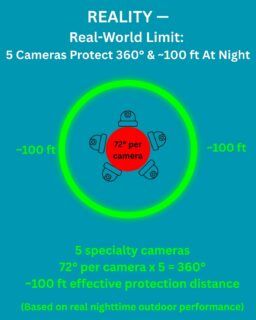
Testing should cover more than the center of one camera view. It should include:
- The center and outer portions of every view
- Transitions between adjacent cameras
- A person approaching the cameras
- A person moving laterally across the scene
- The proposed mounting height and angle
- The site’s actual nighttime lighting and obstructions
The final installation should also be revalidated. Specifications and demonstrations cannot account for every effect of the actual terrain, fencing, structures, vibration, and lighting.
A colored coverage circle or daytime screenshot may show what the proposal intends. It does not prove what the installed system will reliably accomplish at night.
6. How Jatagan Evaluates Camera Coverage
Jatagan does not treat four cameras—or five cameras—as a universal answer.
The evaluation begins with the required result:
- Where must a potential threat first be detected?
- What must the system determine at that point?
- What are the nighttime and environmental conditions?
- How much time is available for deterrence or escalation?
- Which camera, optics, illumination, analytics, and mounting configuration can meet that requirement?
This approach works backward from the security objective instead of forward from a predetermined camera count.
A four-camera multidirectional configuration may be appropriate for a compact area requiring broad awareness. Another site may need focused directional cameras, overlapping views, thermal imaging, or fewer purpose-built long-range cameras.
For extended perimeters, Jatagan may use its Range-Boosted AI Camera SystemTM, designed to provide up to approximately 1,600 feet of perimeter coverage with two cameras in suitable configurations, including complete-darkness applications.
That system should not be compared with a standard four-camera layout only by counting cameras or adding viewing angles. The equipment and deployment are designed around a different objective: extended perimeter detection.
The important question is not:
“How many cameras are included?”
It is:
“Does the proposed system meet the required security outcome across the actual site?”
Conclusion
Can four security cameras cover 360° at 150 feet?
They can provide nominal 360° horizontal coverage. Commercial four-head multidirectional cameras are designed for that purpose.
But the phrase “at 150 feet” remains incomplete until the provider defines:
- What must be detected or understood
- Whether AI, an operator, or both perform the task
- The required level of visual detail
- The camera, lens, lighting, and analytics
- The target and test conditions
- How performance will be validated after installation
The right response to the claim is not:
“That is impossible.”
It is:
“What can the system reliably accomplish at 150 feet, under the actual conditions of this site—and can you demonstrate it?”
That question turns a marketing claim into a measurable security requirement.
Frequently Asked Questions
Can Four Security Cameras Provide Complete 360° Coverage?
Yes. Four properly configured camera views can provide nominal 360° horizontal coverage. Commercial multidirectional cameras are available with four independently adjustable heads designed to provide up to 360° coverage.
The result still depends on camera positioning, overlap, mounting, obstructions, lighting, and the required level of detail.
Can Four 90° Cameras Detect a Person at 150 Feet?
Possibly. The viewing angles alone do not establish detection performance.
The result depends on the camera resolution, sensor, lens, lighting, analytics, mounting, target size, target position, weather, and the meaning of “detection.” A system may show a person at 150 feet without reliably classifying the person or allowing an operator to assess the activity.
Is Seeing a Person at 150 Feet the Same as Identifying the Person?
No. A person may be visible as a small figure and may even be classified by AI without the image containing enough detail to recognize or identify the individual.
General visibility, AI detection, behavioral assessment, recognition, and identification are different performance outcomes.
What Proof Should a Provider Supply for a 150-Foot Coverage Claim?
Request the exact camera and lens specifications, the defined security objective, lighting and analytics settings, mounting conditions, and actual nighttime footage recorded at approximately 150 feet.
Testing should include the center and outer portions of every camera view, transitions between cameras, and the conditions expected at the installed site.