


Table of Contents
- Introduction
- What Is a Vertically Integrated Security Company?
- The Problem with Outsourced Security Models
- Jatagan’s Full Security Stack Explained
- Benefits of a Fully Integrated Security System
- Comparison: Integrated vs. Outsourced Security
- Why “No Gaps” Matters in Security
- Security Solutions in Northern California
- Conclusion
- FAQ
Introduction
Most outdoor video security companies stitch together multiple vendors—creating gaps, disconnections, and risk at every handoff.
Jatagan Security takes the opposite approach.
As a vertically integrated security company, Jatagan owns and operates the entire security stack—from research and development to real-time monitoring in the United States.
The result: no outsourcing, no handoffs, and no gaps.
This approach is delivering stronger, more reliable protection for businesses across Northern California, including Sacramento and the San Francisco Bay Area.
What Is a Vertically Integrated Security Company?
A vertically integrated security company controls every stage of its product and service lifecycle internally. This includes:
- Designing the technology
- Manufacturing the equipment
- Deploying systems in the field
- Maintaining and servicing the security systems
- Monitoring and responding to threats
Instead of relying on multiple vendors, everything is built and operated under one umbrella and one standard.
At Jatagan, this philosophy is simple:
One system. One standard. No gaps.
The Problem with Outsourced Security Models
Many outdoor video security providers rely heavily on third-party vendors. While common, this model introduces real risks:
1. Fragmented Systems
Different vendors use different technologies, leading to integration issues and inconsistent performance.
2. Slower Response Times
When multiple parties are involved, communication delays slow down incident response.
3. Lack of Accountability
Responsibility is often unclear when something fails, leading to finger-pointing instead of solutions.
4. Increased Long-Term Costs
Hidden costs accumulate through maintenance, upgrades, and inefficiencies.
5. Security Gaps
Each vendor handoff introduces potential vulnerabilities—where failures often occur.
For businesses operating in fast-moving environments like Sacramento construction sites or Bay Area commercial properties, these gaps can translate into real financial loss.
Jatagan’s Full Security Stack Explained
Jatagan eliminates these challenges by owning the entire lifecycle. The Jatagan Security Stack includes:
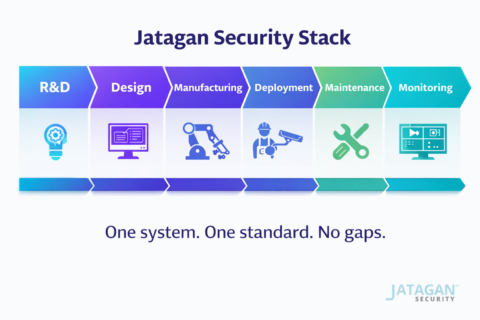
- R&D: Continuous innovation in outdoor video security technology
- Design: Purpose-built systems engineered for real-world environments
- Manufacturing: In-house production ensures quality and consistency
- Deployment: Professional installation and system configuration
- Maintenance: Ongoing support and optimization
- Monitoring: 24/7 U.S.-based monitoring center
Every Jatagan Security Stack layer is connected, controlled, and optimized internally—ensuring consistent performance across all environments.
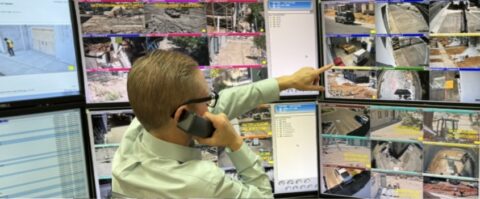
[Jatagan’s U.S.-based monitoring center provides real-time surveillance and rapid response with full system integration.]
Benefits of a Fully Integrated Security System
When everything is built and operated under one roof, the benefits are clear:
Higher Reliability
Systems are designed to work together from day one, reducing failure points.
Better Performance
Integrated systems enable better detection, smarter alerts, and more effective responses.
Lower Costs
Eliminating third-party vendors reduces duplication, inefficiencies, and long-term expenses.
Stronger Accountability
One provider is responsible for everything—no confusion, no finger-pointing.
Seamless Integration
All components function as a unified system, not disconnected parts.
Comparison: Vertically Integrated vs. Outsourced Security
|
Feature |
Vertically Integrated (Jatagan) |
Outsourced Model |
|
System Design |
In-house, unified |
Multiple vendors |
|
Accountability |
Single provider |
Fragmented |
|
System Compatibility |
Fully integrated |
Can be mismatched |
|
Maintenance |
Centralized |
Vendor-dependent |
|
Cost Efficiency |
Optimized long-term |
Hidden costs |
|
Security Gaps |
Minimal |
Higher risk |
|
Performance |
Optimized |
Lower |
Why “No Gaps” Matters in Security
Security is only as strong as its weakest point.
In outsourced models, gaps appear between:
- Technology providers
- Installers
- Maintenance teams
- Monitoring services
These gaps create vulnerabilities and potential missed threats.
Jatagan’s vertically integrated model eliminates these vulnerabilities.
By controlling every layer, Jatagan ensures:
- Custom-designed protection
- Continuous system visibility
- Consistent performance
In security, there is no margin for error. That’s why “no gaps” is not just a message—it’s a requirement.
Security Solutions in Northern California
Jatagan Security delivers vertically integrated security solutions across Northern California, with a strong presence in:
From construction sites and industrial facilities to commercial properties, Jatagan’s full-stack approach ensures:
- Better quality assurance
- Consistent system performance
- Reliable monitoring and response
For organizations operating in high-risk or high-value environments, having a single provider managing the entire system eliminates complexity—and significantly improves outcomes.
Conclusion
The traditional outsourced security model is no longer sufficient for modern threats.
Businesses need:
- Faster response times
- Greater reliability
- Clear accountability
- Cost efficiency
Jatagan delivers all of this through a vertically integrated approach.
From concept to protection, every layer is built, deployed, and operated in-house in the United States.
No outsourcing. No handoffs. No gaps.
That’s what modern security should look like.
Request a free security assessment today.
FAQ
What does “full security stack” mean?
A full security stack includes all components of a security solution—design, manufacturing, deployment, maintenance, and monitoring—working together as one system.
Why is vertical integration important in security?
Vertical integration improves reliability, reduces delays, lowers costs, and eliminates vulnerabilities between systems.
How does Jatagan differ from other security companies?
Jatagan owns and operates the entire security stack in-house, rather than relying on third-party vendors.
Does vertical integration reduce costs?
Yes. It reduces long-term costs by eliminating vendor markups, inefficiencies, and system incompatibilities.
Where does Jatagan provide security services?
Jatagan serves businesses across Northern California, including Sacramento and the San Francisco Bay Area, with fully integrated security solutions.
What types of businesses benefit from integrated security?
Industries such as construction, logistics, infrastructure, and commercial real estate benefit the most from reliable, real-time security systems.