


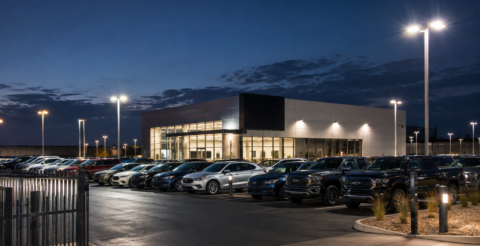
Car dealerships are unusual security environments. A large portion of the inventory is stored outdoors, often spread across multiple lots, service areas, overflow parking and perimeter edges. During business hours, employees, customers and vehicles create constant activity. After closing, the same property can become quiet very quickly.
That creates a different security problem from most retail businesses. The showroom may be locked and the alarm armed, but dozens or even hundreds of high-value vehicles remain outside.
Effective car dealership security therefore depends on more than protecting the building. Dealers also need to consider how someone could enter the property, move between vehicles, approach service areas or remain out of view after hours.
Table of Contents
- Why Auto Dealerships Are Difficult to Secure
- Vehicle Lots and Outdoor Inventory
- Rear Lots and Overflow Parking
- Service Bays and Parts Areas
- Perimeter Access and Secondary Entrances
- Blind Spots Between Vehicles
- Theft of Wheels, Catalytic Converters and Vehicle Parts
- Detection and Response After Hours
- Car Dealership Security at a Glance
- What to Review After an Incident or Attempt
- Frequently Asked Questions
Why Auto Dealerships Are Difficult to Secure
Most businesses bring their valuable inventory indoors at night. Auto dealerships do the opposite.
Vehicles remain outside, often close to public streets and parking areas. Some properties have several acres of inventory, multiple entrances, service buildings, storage areas and sections of the lot that are difficult to see from the showroom.
The layout changes constantly as vehicles are sold, delivered, moved for service or rearranged on the lot. A camera view that worked well one month may become partially blocked by a row of SUVs the next.
Dealerships also tend to have several different types of risk at the same property. Someone may be interested in stealing an entire vehicle, removing wheels or catalytic converters, entering a service area, damaging inventory or simply trespassing through the lot after hours.
That is why auto dealership security systems should be designed around the full property rather than only the showroom and main entrance.
1. Vehicle Lots and Outdoor Inventory
The most obvious exposure is also the largest: the vehicle inventory itself.
A dealership may have hundreds of vehicles parked close together, creating long rows and narrow lanes. Those rows can make it difficult for cameras to maintain clear views across the property.
Security planning should consider not only whether cameras can see the lot, but whether they can detect someone approaching or moving between vehicles after hours.
Lighting helps, but it does not solve every problem. Strong illumination near the showroom can leave other sections of the lot comparatively dark. Large vehicles can also block both lighting and camera views.
A useful review should ask:
- Which parts of the lot are visible after dark?
- Can someone move between rows without being observed?
- Are the most valuable vehicles concentrated in areas with strong coverage?
- Does the system provide enough warning before someone reaches the inventory?
The goal is early detection, not simply recording someone once they are already next to a vehicle.
2. Rear Lots and Overflow Parking
Front-line inventory usually receives the most attention because it is highly visible to customers.
Rear lots can be very different.
Overflow inventory, trade-ins, used vehicles, employee cars or vehicles awaiting service may be parked behind buildings or along less visible property lines. These areas can be farther from employees, street traffic and primary lighting.
They may also be easier to approach from neighboring properties or secondary roads.
Dealerships should evaluate rear and overflow lots separately from the main display area. A camera system designed primarily around the customer-facing side of the property may leave meaningful gaps behind the building.
This is especially important for dealerships that expand into adjacent lots over time. A temporary overflow area can become a permanent part of operations without receiving the same level of security planning as the original property.
3. Service Bays and Parts Areas
The service side of a dealership has a different pattern of risk.
Service bays may contain customer vehicles, tools, diagnostic equipment and parts. Doors are often larger than ordinary retail entrances and may open directly onto parking or work areas.
Parts departments can also contain items that are easier to remove and resell than an entire vehicle.
After hours, dealerships should consider whether service entrances, roll-up doors and nearby parking areas can be approached without being detected.
Camera placement should include the routes leading to these areas rather than focusing only on the doors themselves.
Operational procedures matter as well. Vehicles awaiting repair should not be left in locations that are easy to access from outside the property if a more secure area is available.
4. Perimeter Access and Secondary Entrances
Main entrances are typically well lit and highly visible. They may also be blocked or gated after closing.
Someone attempting to enter after hours may look elsewhere.
Side driveways, rear gates, gaps between neighboring properties and sections of fencing away from the showroom can provide easier access.
For larger dealerships, perimeter length becomes a major design consideration. Covering the front of the property well does not necessarily provide useful visibility along remote sections of the lot.
Dealers should walk the perimeter at night and look at it from the outside. Where could someone enter without being seen from the building? Which areas are screened by landscaping, walls or parked vehicles?
Those locations deserve attention even if they are rarely used during normal operations.
5. Blind Spots Between Vehicles
Vehicles themselves are one of the biggest obstacles to dealership surveillance.
Rows of trucks, SUVs and vans can create substantial blind spots, especially for cameras mounted at lower heights or positioned too far from the areas they are intended to protect.
The problem changes from day to day because the inventory moves.
This means dealership security should not be evaluated only when the system is first installed. Camera views should be reviewed periodically to make sure they still provide useful coverage.
It may also make sense to use different camera types for different purposes. A wide-angle view can provide general awareness, while narrower or longer-range cameras may be more useful for perimeter detection.
The right design depends on the lot, the vehicle mix and the distances involved.
6. Theft of Wheels, Catalytic Converters and Vehicle Parts
Vehicle theft remains a significant national problem. Not every dealership theft involves stealing a complete vehicle, thieves also target valuable components and parts.
Wheels, tires, catalytic converters and other components can be attractive because they may be removed quickly and transported more easily than an entire car.
These incidents can also affect multiple vehicles in a single night.
The security challenge is different from vehicle theft. Someone may spend time crouched beside or underneath a car rather than attempting to move it.
Dealers should pay attention to areas where rows of vehicles provide concealment and where someone could work without being visible from the street or building.
The placement of higher-risk inventory can also matter. If certain vehicle models or components are being targeted repeatedly, moving them into better-covered areas may reduce exposure while longer-term security changes are made.
7. Detection and Response After Hours
Cameras are valuable, but the outcome depends on what happens when suspicious activity is detected.
A recorded video may help identify what happened later. It does not necessarily stop the loss.
For dealerships using live video monitoring, it is important to understand the response process.
Questions worth asking include:
- When does a monitoring operator become involved?
- Can suspicious activity be assessed before someone reaches a vehicle?
- Can the system issue a live warning?
- Are lights or sirens available?
- Who is contacted if the person does not leave?
- When is law enforcement escalation appropriate?
The earlier suspicious activity is identified, the more options there are for intervention.
A person walking through a closed dealership lot at 2 a.m. may not have committed a crime yet, but that activity can still warrant attention. Waiting until a window is broken or a vehicle is damaged reduces the opportunity to prevent the incident.
Car Dealership Security at a Glance
| Area | Common vulnerability | What to evaluate |
|---|---|---|
| Main vehicle lot | Large outdoor inventory and changing sight lines | Nighttime visibility, detection range and camera placement |
| Rear/overflow lot | Lower visibility and less employee activity | Perimeter access and coverage after hours |
| Service area | Customer vehicles, tools and large doors | Approaches, bay doors and adjacent parking |
| Parts area | Smaller high-value items | Access points and after-hours visibility |
| Perimeter | Secondary entrances and remote property lines | Fence lines, gates and neighboring access |
| Vehicle rows | Cars and trucks create blind spots | Camera height, angle and periodic review |
| After-hours response | Activity may be recorded but not stopped | Monitoring, deterrence and escalation |
What to Review After an Incident or Attempt
An attempted theft, vandalism event or suspicious after-hours visit can reveal more about the property than a routine inspection.
Start by reviewing how the person approached the dealership.
Did they enter from the street, a side property or a rear fence line? How long were they visible before reaching the vehicles? Were there areas where they disappeared from camera view?
Then look at the response.
Was the activity detected while it was happening? Did anyone assess it? Was there a warning or other intervention? If law enforcement was contacted, how much time had passed by then?
Finally, correct the specific weakness that was exposed.
That may involve changing a camera angle, improving lighting, relocating higher-risk vehicles, reinforcing a gate or adding coverage to a rear section of the property.
Repeated activity should receive particular attention. If people keep testing the same area, there is usually a reason.
For dealerships, the objective is not to make every square foot equally secure. It is to understand where the property is most vulnerable after hours and make sure those areas can be detected, monitored and responded to effectively.
Jatagan provides car dealership security solutions and live monitoring for outdoor vehicle lots throughout Northern California, including the Sacramento region and San Francisco Bay Area, with systems designed around perimeter coverage, blind spots and after-hours intervention.
Frequently Asked Questions
1. What are the biggest security risks at car dealerships?
Common risks include vehicle theft, wheel and tire theft, catalytic converter theft, vandalism, unauthorized access, break-ins at service areas and activity in poorly monitored rear or overflow lots.
2. Are security cameras enough to protect a car dealership?
Cameras are an important part of dealership security, but their effectiveness depends on placement, nighttime visibility, detection range and response. Cameras that only record an incident may provide useful evidence without preventing the loss.
3. Where should dealership security cameras be placed?
Camera placement should be based on the property layout. Typical priorities include vehicle lots, entrances, rear and side access points, service bays, parts areas, perimeter sections and routes someone would use to approach the inventory.
4. How can dealerships reduce blind spots in vehicle lots?
Blind spots can be reduced by reviewing camera height and placement, using appropriate camera types and periodically checking views as vehicle inventory changes. Rows of large vehicles can block sight lines that were clear when cameras were originally installed.
5. Should rear and overflow lots have separate security coverage?
Often, yes. Rear and overflow lots may have different access points, lighting and sight lines from the main customer-facing lot. They should be evaluated as separate risk areas rather than assumed to be covered by the same cameras.
6. What should a dealership do after an attempted theft or vandalism incident?
Review how the person entered, where they moved, what they targeted and whether the activity was detected early enough to respond. Then address the specific weakness revealed by the incident, such as a blind spot, vulnerable access point or inadequate after-hours monitoring.