


Table of Contents
Overview
Levels of Protection in 24/7 Video Security Monitoring
Passive Deterrence Only
Notification-Based Deterrence
Basic Security Provider
Standard Security Provider
Enhanced Security Provider
Best Security Provider: The Jatagan Standard
Frequently Asked Questions (FAQ)
Overview
he following clarifies the differences among varies types of 24/7 video security monitoring providers. To choose the best available in the industry, it is essential to clearly understand what the provider offers as it often determines your protection results.
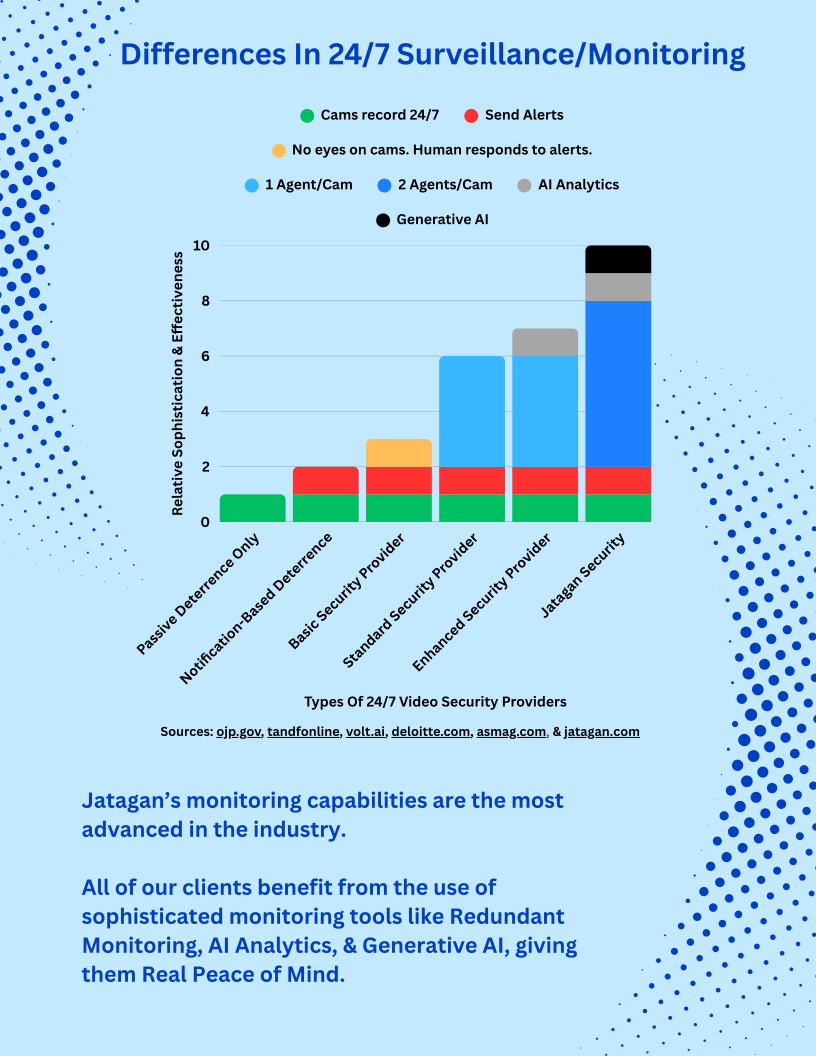
Levels Of Protection In 24/7 Video Security Monitoring
(From Low To High)
1. Passive Deterrence Only
For decades, “24/7 video security monitoring” implied round-the-clock recording — cameras quietly capturing everything, while human operators (can be the client or security staff) reviewed recorded footage upon discovery of problems. But as anyone in modern security operations knows, passive recording isn’t the same as monitoring. This type of provider is low in cost, but also very low in effectiveness..
2. Notification-Based Deterrence
As time progresses, video security providers use cameras with analytics to send alerts to clients. This notification-based system has low effectiveness as it is impossible for clients to respond to alerts 24/7. Not to mention it doesn’t have humans watching the cameras and understanding the situation.
3. Basic Security Provider
This type of service is similar to home alarm systems. When alerts are triggered, security staff will notify the client or call the Police Department or Fire Department. However, it still does not have humans watching the cameras and understanding the situation. Response is delayed, often in minutes, which can make all the difference in preventing loss or harm.
4. Standard Security Provider
A better monitoring model engages a monitoring agent who uses human intelligence to analyze situations and make appropriate decisions. Unfortunately, humans do experience fatigue and burnout and are not entirely reliable at all times.
5. Enhanced Security Provider
Some standard security providers have taken advantage of the recent advances in AI analytics and incorporated the technology into their cameras and systems. AI models now help distinguish between routine activity and genuine risk — filtering noise and providing better alerts.
By combining a human monitoring agent and AI analytics, this type of provider has greatly enhanced the effectiveness of 24/7 video security monitoring. However, AI still generates a high number of false alerts and can cause fatigue and burnout for the monitoring agent.
6. Best Security Provider
Jatagan Security sets a new standard in 24/7 video security monitoring. Apart from AI analytics, we have added Generative AI to our system, which adds another layer of effectiveness in protection.
In addition, Jatagan’s patented Redundant Live Monitoring System engages two trained agents per camera instead of just one. This overlapping provides superior redundancy, efficiency, and reliability without significant additional cost to our clients.
By incorporating all the above, Jatagan Security has consistently delivered a Crime Prevention Success Rate of over 99.9%, setting the benchmark for outdoor video security performance. After all, when it comes to security, isn’t it the result that matters most? That’s why our clients have trusted us for over 20 years!
Frequently Asked Questions (FAQ)
What does “24/7 video security monitoring” actually mean?
The term is often used loosely. True 24/7 monitoring means continuous analysis, understanding, and response to live video — not just recording footage or sending automated alerts. The level of protection depends entirely on whether humans, AI, or both are actively monitoring and intervening in real time.
Why is passive recording considered low protection?
Passive systems only document events after they occur. While footage can be useful for investigations, it does nothing to stop theft, vandalism, or intrusion in progress. In security, prevention is far more valuable than documentation.
Why are notification-based systems ineffective?
Notification-based systems rely on clients to respond to alerts at all hours. This is unrealistic and unreliable. Without trained professionals actively monitoring and interpreting events, alerts are often missed, ignored, or misjudged.
How is a basic security provider different from a standard provider?
Basic providers typically react to alarms by notifying clients or authorities, similar to traditional alarm systems. Standard providers improve on this by adding a live monitoring agent who evaluates the situation, but response quality still depends heavily on a single human operator.
What role does AI play in enhanced security providers?
AI analytics help identify people, vehicles, and unusual behavior while filtering out routine activity. This improves accuracy and efficiency, but AI alone still produces false alerts and can overload human operators if not properly managed.
Why is redundancy important in video monitoring?
Single-agent monitoring creates a single point of failure. Fatigue, distraction, or human error can lead to missed threats. Redundancy ensures continuous awareness and dramatically improves reliability in real-world conditions.
What makes Jatagan Security the highest level of protection?
Jatagan combines AI analytics, Generative AI, and a patented Redundant Live Monitoring System that assigns two trained agents per camera. This layered approach minimizes false alerts, reduces fatigue, eliminates blind spots, and enables real-time prevention instead of delayed reaction.
What does a 99.9% crime prevention success rate mean in practice?
It means that threats are detected, evaluated, and deterred before losses occur — consistently. This outcome-focused performance is the result of combining advanced technology with human intelligence and redundancy, rather than relying on any single component.
Why does choosing the right monitoring provider matter so much?
Because security outcomes are determined by response speed, accuracy, and reliability. The difference between recording an incident and preventing it often comes down to seconds — and to the monitoring model behind the system.