


Table of Contents
- Introduction
- What Is Outdoor Video Security Monitoring?
- Threat Detection: AI vs Human Monitoring
- Why AI Misses Threats in Outdoor Environments
- Jatagan’s AI-Augmented Human Detection & Monitoring Model
- Intervention: Preventing Crime in Real Time
- Reliability: Measuring Security Effectiveness
- Differences in Outdoor Video Security
- Where Outdoor Video Monitoring Is Most Effective
- How to Choose an Outdoor Security Provider
- Frequently Asked Questions
1. Introduction
Artificial intelligence has transformed surveillance technology, but many security providers have recently shifted toward AI-only monitoring models to reduce operating costs. In these systems, humans are no longer actively watching cameras—they simply verify alerts generated by AI.
While AI improves efficiency, relying on it alone introduces a critical weakness:
AI systems frequently miss real threats in unpredictable outdoor security environments.
Lighting conditions change, weather impacts visibility, and individuals often appear only partially within a camera frame.
Effective outdoor security requires three essential components:
-
Threat Detection
-
Intervention
-
Reliability
Jatagan Security’s AI-augmented human detection and monitoring model combines artificial intelligence with redundant human monitoring to deliver stronger detection and crime prevention.
2. What Is Outdoor Video Security Monitoring?
Outdoor video security monitoring refers to real-time surveillance of property using cameras combined with detection/alert systems with/without remote monitoring personnel.
Typical systems include:
-
Security cameras
-
Motion or AI detection
-
Remote monitoring operators
-
Audio-Visual deterrences
-
Incident response protocols
Outdoor monitoring is commonly used to protect:
-
Construction sites
-
Industrial facilities
-
Equipment yards
-
Commercial properties
-
Vacant buildings and land
The goal is simple: detect threats early and prevent crime before it occurs.
However, the effectiveness of these systems varies significantly depending on how detection and response are structured.
3. Threat Detection: AI vs Human Monitoring
Many modern surveillance providers have shifted toward AI-only monitoring models.
These systems follow a simple workflow:
-
AI analyzes video footage
-
AI generates alerts
-
A human operator verifies the alert
-
The operator responds if necessary
This means the human operator is not actively watching cameras.
Instead, they simply respond when AI detects something.
If the AI fails to detect a threat, no alert is created and no human sees the event.
In outdoor security environments, this can lead to missed threats.
4. Why AI Misses Threats in Outdoor Environments
Artificial intelligence performs well in controlled conditions but struggles with environmental variables that occur outdoors.
Common challenges include:
-
Low lighting conditions
-
Rain, fog, or snow
-
Partial visibility of individuals
-
Camera obstructions
-
Shadows or background movement
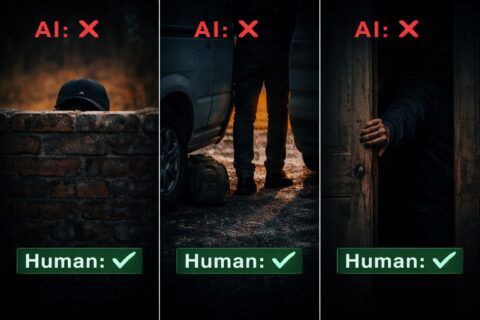
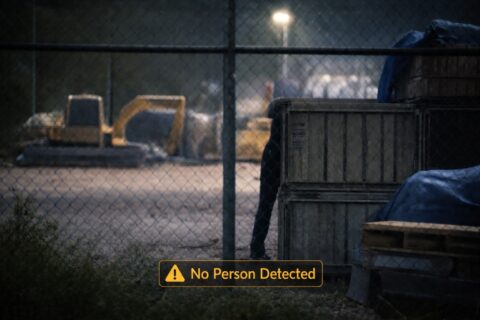
Because of these factors, AI detection systems operating in outdoor environments typically detect only about 70–85% of threats.
This means that 15–30% of threats may not trigger alerts at all.
When this happens:
-
No alert is generated
-
No operator reviews the footage
-
The threat goes unnoticed
In security systems, this type of failure is called a false negative.
5. Jatagan’s AI-Augmented Detection & Monitoring Model
Jatagan Security uses AI-augmented human detection and monitoring to improve accuracy and reliability.
Instead of relying solely on AI alerts, Jatagan introduces multiple detection layers.
LAYER 1
AI DETECTION
───────────────────
• Continuous video analysis
• Detects people, vehicles, and suspicious movement
• Generates alerts
↓
LAYER 2
HUMAN MONITORING AGENT
───────────────────
• Actively monitoring cameras
• Identifies suspicious activity AI may miss
• Initiates deterrence and response
↓
LAYER 3
SECOND MONITORING AGENT
───────────────────
• Redundant monitoring layer
• Catches events missed by AI or the first agent
• Ensures threats do not slip through
Why Redundant Monitoring Improves Security
In high-risk environments, redundancy is a standard safety principle.
Examples include:
-
Aviation systems
-
Cybersecurity operations centers
-
Emergency response dispatch
Security monitoring benefits from the same approach.
Jatagan’s dual-agent monitoring model dramatically reduces missed threats and improves overall detection reliability.
This layered system allows AI and humans to complement each other’s strengths.
6. Intervention: Preventing Crime in Real Time
Detecting a threat is only the first step in security.
Effective crime prevention requires immediate intervention.
Many camera systems simply record incidents or send notifications after an event occurs. Jatagan focuses on real-time deterrence.
Multi-Sensory Deterrence: Audio and Visual Warnings
Jatagan systems also support strong audio and visual deterrence tools, including:
-
Loud sirens
-
High-volume horns
-
Bright flashing strobe lights
-
Verbal warnings
Flashing strobes are particularly effective at night or in low-visibility environments, increasing the psychological impact of the warning.
Verbal intervention through security system speakers, such as
“You are entering a restricted property. Authority has been notified. Please leave immediately.”
often stops criminal activity before it escalates.
Together, these tools create a multi-sensory deterrence environment, making it immediately clear that individuals have been detected and are being monitored. In most cases, they cause trespassers to leave immediately.
Situation-Specific Response Protocols
Monitoring agents follow structured procedures depending on the incident type.
Examples include:
-
Trespassing
-
Loitering
-
Suspicious vehicles
-
Attempted theft
-
Property damage
Each scenario has defined responses to maximize deterrence.
Escalation to Authorities
If individuals fail to leave the property, operators can escalate the situation by:
-
Dispatching onsite security personnel
-
Notifying property managers
-
Contacting local law enforcement
Rapid escalation ensures threats are addressed quickly.
7. Reliability: Measuring Security Effectiveness
A major challenge in the security industry is lack of transparency about real performance.
Many providers highlight activity metrics, such as:
-
Number of cameras monitored
-
Number of alerts generated
-
Hours of video footage reviewed
While these numbers demonstrate operational scale, they do not measure actual crime prevention.
The key question for property owners is simple:
Did the system stop the crime?
Jatagan focuses on outcome-based performance metrics – Crime Prevention Effectiveness – specifically measuring how often threats are prevented before crimes occur.
8. Differences in Outdoor Video Security
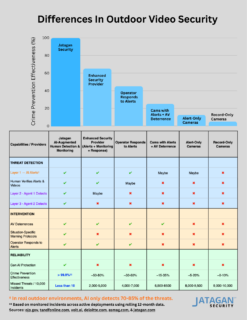
The infographic below compares several outdoor security models, including:
- Jatagan’s AI-augmented detection & monitoring
- Enhanced security provider (alerts + monitoring + response)
- Operators responds to alerts
- Cams with alerts + AV deterrences
- Alert-only camera systems
- Record-only camera systems
It illustrates how detection layers and response capabilities impact overall crime prevention effectiveness.
Sources: ojp.gov, tandfonline.com, volt.ai, deloitte.com, asmag.com, & jatagan.com
9. Where Outdoor Video Monitoring Prevents the Most Crime
Outdoor monitoring is especially valuable in environments where valuable assets are stored but staff presence is limited.
Common applications include:
Construction Sites
Protect building materials, copper wiring, and heavy equipment from theft.
Equipment Yards
Prevent organized theft targeting machinery and vehicles.
Industrial Facilities
Monitor large outdoor properties and restricted areas.
Commercial Properties
Protect parking lots, warehouses, and distribution centers.
Vacant Properties
Prevent trespassing, vandalism, and illegal dumping.
10. How to Choose an Outdoor Security Provider
When evaluating security monitoring providers, it is important to understand how their systems operate.
Key questions include:
Is threat detection AI-only or with human augmentation?
If the AI misses a threat, will anyone see it?
Are operators actively watching cameras?
Or do they only review alerts?
What deterrence methods are available?
Effective systems should support:
-
Voice warnings
-
Audible alarms
-
Visual deterrence such as flashing strobes
How does the provider measure effectiveness?
Activity metrics are not the same as crime prevention outcomes.
Is there redundancy in monitoring?
Multiple detection layers reduce missed threats.
The Future of Outdoor Security Monitoring
The future of security is not AI replacing humans.
It is AI working with humans.
By combining artificial intelligence detection with trained monitoring agents and real-time intervention, security systems become significantly more effective at preventing crime.
Jatagan Security’s AI-augmented detection & monitoring approach delivers stronger detection, faster intervention, and greater reliability in real outdoor environments.
11. Frequently Asked Questions
Is AI security monitoring reliable outdoors?
AI can detect many threats but environmental conditions affect accuracy. In outdoor deployments, AI typically detects 70–85% of threats, meaning some threats may not generate alerts.
What is AI-augmented monitoring?
AI-augmented monitoring combines artificial intelligence detection with active human surveillance, improving detection accuracy and reliability.
Why does Jatagan use two monitoring agents?
Two monitoring agents create redundancy. If one operator or AI system misses a threat, the second agent can detect it.
How does remote video monitoring prevent crime?
Monitoring operators intervene in real time using voice warnings, alarms, and escalation protocols to stop incidents before crimes occur.