


Table of Contents
Introduction: The AI Surveillance Promise vs. Reality
How Modern AI Video Analytics Actually Work
Problem# 1: The Fence, Shade, and Occlusion
Problem #2: Partial Human Visibility — When AI Misses What Humans Instantly See
Problem # 3: Low-Light and Poor Lighting Conditions
Context, Intuition, and Intent: The Human Advantage
AI + Human Monitoring: A Comparative Table
The Real-World Security Risk of Over-Reliance on AI
The Future: Augmented Intelligence, Not Replacements
Conclusion
Frequently Asked Questions (FAQ)
1. Introduction: The AI Surveillance Promise vs. Reality
Artificial intelligence has rapidly become the centerpiece of modern physical security systems. Vendors promise “24/7 automated monitoring,” “instant threat detection,” and “human-free security operations.” On paper, AI-powered alerts appear faster, cheaper, and more scalable than traditional human monitoring.
However, in real-world deployments, state-of-the-art AI detection still fall short of human monitoring in critical scenarios—especially when visibility is imperfect, environments are complex, or intent must be inferred.
At Jatagan Security, we consistently see one truth emerge from operational data and incident reviews:
AI excels at pattern recognition in ideal conditions, but humans excel at judgment in real conditions.
2. How Modern AI Video Analytics Actually Work
To understand AI’s limitations, it is important to understand how it “sees.”
Most video AI systems rely on:
Object detection models trained on labeled datasets
Bounding boxes around full human silhouettes
Confidence thresholds to trigger alerts
Pixel-level consistency across frames
In other words, AI does not “understand” a scene. It matches visual patterns to statistical probabilities. When the input deviates from what it was trained on, performance drops sharply.
Human operators, by contrast, do not rely on perfect inputs. They interpret incomplete, ambiguous, and degraded visual information every day.
3. Problem #1: The Fence, Shade, and Occlusion
Why AI Struggles
AI detection models often fail when:
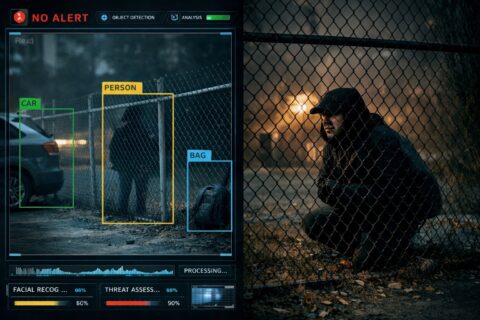
A person is partially or fully obscured by a fence
A person is standing behind mesh, bars, or grating
A person is concealed by shadows or shade structures
From an AI perspective, fences introduce:
Visual noise
Repetitive line patterns
Occluded body contours
As a result, the system either:
Fails to detect a person entirely, or
Misclassifies the person as background or static objects
Why Humans Succeed
Human monitors:
Mentally “see through” fences
Recognize motion inconsistencies
Infer human presence from posture, movement rhythm, and context
A human does not need a clean silhouette to know, “Someone is standing where they shouldn’t be.”

4. Problem # 2: Partial Human Visibility — When AI Misses What Humans Instantly See
AI’s Full-Body Dependency
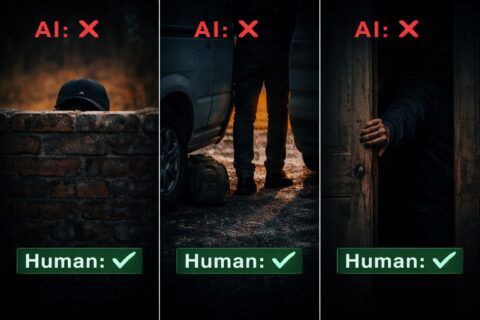
Most AI systems are trained to detect entire human forms. When only:
A head
Legs
An arm
A shoulder
is visible, detection confidence drops below alert thresholds.
This is common in:
Tight camera angles
Perimeter breaches
Rooftop access points
Blind-spot edges
Human Pattern Completion
Humans excel at pattern completion:
Legs moving under a vehicle = a person
A head rising above a wall = a person
Arm movement behind a structure = a person
This capability is evolutionary and instantaneous. AI, by contrast, does not “fill in gaps” unless explicitly trained on millions of similar partial examples—which still does not guarantee reliability.
5. Problem # 3: Low-Light and Poor Lighting Conditions
AI’s Sensitivity to Lighting
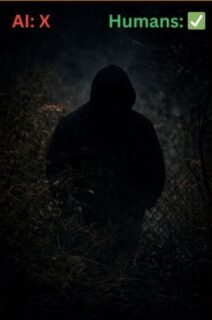
Despite advances in low-light cameras, AI detection remains highly sensitive to:
Insufficient illumination
Uneven lighting
Glare and bloom
Nighttime noise artifacts
In poor lighting:
AI confidence scores drop
False negatives increase
Alerts are suppressed to avoid false positives
Human Visual Adaptation
Humans:
Adjust perception dynamically
Recognize silhouettes, movement, and contrast
Combine visual cues with environmental knowledge (time, location, behavior)
A human operator can say, “That shadow is moving against the wind pattern—something is wrong.” AI cannot.
6. Context, Intuition, and Intent: The Human Advantage
Perhaps the greatest gap between AI and humans is contextual reasoning.
AI can answer:
“Is there a detectable object resembling a person?”
Humans can answer:
“Does this behavior indicate threat, intent, or escalation?”
Humans evaluate:
Time of day
Restricted vs. public zones
Normal vs. abnormal movement
Suspicious dwell time
Body language and hesitation
Security incidents are rarely binary. They unfold gradually—and humans are far better at detecting early signals.
7. AI + Human Monitoring: A Comparative Table
| Capability | AI Alerts | Human Monitoring |
|---|---|---|
| Detect behind fences | ❌ Often fails | ✅ Consistently detects |
| Detect partial body (head/legs) | ❌ Low confidence | ✅ Immediate recognition |
| Low-light detection | ❌ Degraded performance | ✅ Adaptive perception |
| Context awareness | ❌ Limited | ✅ High |
| Intent assessment | ❌ None | ✅ Strong |
| Scalability | ✅ High | ⚠️ Moderate |
| Judgment under ambiguity | ❌ Weak | ✅ Strong |
| Response escalation | ❌ Rule-based | ✅ Situational |
8. The Real-World Security Risk of Over-Reliance on AI
Over-reliance on AI detection creates silent failure risks:
No alert does not mean no threat
Missed detections create false confidence
Incident discovery happens after damage occurs
In multiple real incidents, security failures occurred not because cameras were absent—but because AI never triggered an alert, while a human reviewing footage later immediately saw the intrusion. This gap can mean:
Theft
Vandalism
Liability exposure
Operational downtime
9. The Future: Augmented Intelligence, Not Replacements
Based on Jatagan’s internal data, AI-only detection systems using professional-grade equipment are typically 75–85% effective in real-world outdoor environments. Factors such as lighting, weather, obstructions, and partial visibility can significantly reduce AI accuracy.
The future of security is not AI vs. humans. It is:
AI for scale, filtering, and automation
Humans for judgment, context, and decision-making
At Jatagan Security, we go one step further. We advocate redundant human monitoring, where:
AI assists but does not decide alone
- 2 monitoring agents per camera for redundancy and reliability
Humans validate, interpret, and escalate
Technology amplifies—not replaces—human expertise
This hybrid model delivers the highest reliability in real-world environments. That’s how Jatagan consistently achieves a 99.9%+ crime prevention success.
10. Conclusion
State-of-the-art AI alerts are powerful tools—but they are not infallible. Fences, shade, partial visibility, and poor lighting remain fundamental challenges that AI has not fully solved.
Humans, on the other hand, thrive in imperfection.
Until AI can reason, infer intent, and adapt like a human, true security still requires human eyes and human judgment.
11. Frequently Asked Questions (FAQ)
Q1: Does this mean AI surveillance is ineffective?
No. AI is highly effective as a supporting tool, but not as a standalone replacement for human monitoring.
Q2: Can better training data solve these AI issues?
Training helps, but real-world environments are too variable for complete coverage. Edge cases will always exist.
Q3: What environments are most risky for AI-only monitoring?
Perimeters, construction sites, low-light areas, fenced facilities, and locations with poor lighting conditions.
Q4: Is human monitoring more expensive than AI?
Not when factoring in loss prevention, liability reduction, and incident response effectiveness.
Q5: What is the best security approach today?
A layered model combining AI detection with trained human operators.
Q6: How accurate is AI-only video security in outdoor environments?
Based on Jatagan’s internal data, AI-only detection systems using professional-grade equipment are typically 75–85% effective in real-world outdoor environments. Factors such as lighting, weather, obstructions, and partial visibility can significantly reduce AI accuracy.