


Which security camera detects a person farther at night: a 360°, 180°, or 90° camera?
A wider camera angle displays more of the scene, but it does not necessarily provide more usable security coverage. When the same resolution is spread across a broader field of view, a distant person may occupy fewer pixels. At night, illumination must also cover that wider scene.
Field of view describes how much a camera can display. AI detection range describes how far away the system can reliably classify a person under defined conditions.
This article compares common camera types using technical principles and Jatagan’s field observations from outdoor systems operating in complete darkness with built-in infrared illumination.
Bottom line: Under comparable conditions, a narrower field of view generally concentrates more image detail and illumination within the target area. That can support farther nighttime AI human detection. Camera quality, lens, lighting, analytics, mounting, and site conditions can still change the result.
Table of Contents
- Field of View and Detection Range Are Different
- Why Wider Views Can Reduce Detail at Distance
- 360° Fisheye Cameras
- 180° Panoramic Cameras
- 90° Directional Cameras
- Nighttime AI Detection Range Comparison
- Why Coverage-Area Calculations Can Mislead
- How to Evaluate a Detection-Range Claim
- Where Long-Range Specialty Cameras Fit
- Conclusion
- Frequently Asked Questions
1. Field of View and Detection Range Are Different
A camera’s field of view describes the scene included in the image. Detection range describes the distance at which a defined target can be detected under stated conditions.
“Detection” may also mean different things:
| Security outcome | What it means |
|---|---|
| General visibility | A person or object appears in the image |
| AI human detection | Analytics classify the object as a person |
| Behavioral assessment | An operator can determine what the person is doing |
| Recognition or identification | The image contains enough detail to recognize or identify the individual |
A person can be visible without being reliably classified by AI. AI may detect a person while the image still lacks enough detail to assess the activity.
Axis Communications’ pixel-density guidance distinguishes among surveillance objectives and notes that distance, lighting, optics, and compression affect usable detail. It also cautions that standards developed for images interpreted by human operators do not automatically define the requirements of video analytics.
Therefore, “this camera sees 150 feet” is incomplete. The provider should explain what the camera can accomplish at 150 feet, under what lighting, and with which analytics.
2. Why Wider Views Can Reduce Detail at Distance
Pixels on Target
Every camera has a finite resolution. When those pixels cover a wider scene, each distant target generally occupies a smaller portion of the image.
A narrower view places more pixels within a defined area. Axis notes that a smaller field of view can provide higher pixel density when sensor resolution remains the same. It also describes single-sensor 360° cameras primarily as overview tools, with recognition- or identification-level detail generally achieved closer to the camera.
Higher resolution helps, but megapixel count alone does not determine performance. Sensor size, lens quality, exposure, compression, and image processing also matter.
Nighttime Illumination
In complete darkness, a visible-light camera requires infrared or visible illumination. That light must cover the camera’s field of view and reach the target.
Network-video lighting guidance recommends matching the illumination angle to the camera view. A broader beam covers more width; a narrower beam directs more available light into a defined zone. Reflective fencing, license plates, nearby walls, moisture, and foreground objects can also affect exposure.
An advertised infrared distance is therefore not the same as a validated AI human-detection distance.
Distortion and Camera Architecture
A single-sensor 360° fisheye camera records a circular, distorted view. Dewarping can make the image easier to view, but it only rearranges the captured pixels; it does not create additional detail.
Multi-sensor panoramic cameras are different. They use several sensors and lenses and may provide substantially more total resolution. Some multidirectional cameras also use adjustable lenses, combining wide overview views with narrower, more detailed views.
Viewing angle alone cannot predict performance. Camera architecture matters.
Analytics and Site Conditions
Rain, fog, glare, shadows, vegetation, vibration, partial obstruction, target speed, compression, and analytics settings can all change practical detection performance.
There is no universal distance for every camera labeled 360°, 180°, or 90°.
3. 360° Fisheye Cameras
A 360° fisheye camera uses one sensor and one ultra-wide lens to record the surrounding scene.
Its strength is overview coverage. It can be useful in warehouses, lobbies, compact courtyards, covered loading areas, and small open yards where activity remains relatively close.
Its limitation is that one sensor must distribute its resolution across the complete circular view. Distant people may occupy relatively few pixels, and distortion is generally strongest toward the outside of the image.
In Jatagan’s field experience with commonly deployed fisheye cameras operating in complete darkness with built-in infrared and AI human-detection analytics, reliable detection may be approximately 20–25 feet.
4. 180° Panoramic Cameras
A 180° panoramic camera covers one broad side of a scene. It may use one wide-angle lens, several stitched sensors, or multiple adjustable camera heads.
It can work well for façades, loading docks, wide entrances, and parking areas. Performance varies greatly by design: a high-resolution multi-sensor camera can provide far more detail than a basic single-sensor panoramic camera.
The image still covers a broad scene, however, so distant targets may receive fewer pixels than they would in a focused directional view.
In Jatagan’s field experience with commonly deployed 180° panoramic cameras operating in complete darkness with built-in infrared and AI human-detection analytics, reliable detection may be approximately 30–40 feet.
5. 90° Directional Cameras
A 90° directional camera is typically a bullet, turret, dome, or box camera aimed toward one defined area. Its view may be fixed or adjusted through a varifocal lens.
Compared with a single-sensor ultra-wide camera of similar resolution, it can concentrate more pixels and illumination within the target zone. This makes it useful for entrances, gates, fence sections, equipment areas, and known approach routes.
The tradeoff is narrower coverage. Multiple cameras may be required, and poor aiming can waste detail on the sky, ground, or low-risk areas.
In Jatagan’s field experience with commonly deployed 90° directional cameras operating in complete darkness with built-in infrared and AI human-detection analytics, reliable detection may be approximately 50–80 feet.
6. Nighttime AI Detection Range Comparison
| Camera type | Primary strength | Common limitation | Illustrative nighttime AI human-detection range |
|---|---|---|---|
| 360° single-sensor fisheye | Complete overview around one mounting point | Resolution spread across a circular image; limited detail at distance | Approximately 20–25 ft |
| 180° panoramic | Broad coverage along one side or façade | Wide scene can reduce pixels on distant targets; performance varies by design | Approximately 30–40 ft |
| 90° directional | Focused detail and illumination within a defined zone | Requires deliberate aiming and potentially more cameras | Approximately 50–80 ft |
Important: These are Jatagan field observations from commonly deployed cameras operating in complete darkness with built-in infrared and AI human-detection analytics. They are not universal specifications or guarantees. Results vary by model, sensor, resolution, optics, lighting, analytics, mounting, target position, weather, and site conditions.
A premium multi-sensor panoramic camera may outperform a lower-quality directional camera. The table illustrates a common technical pattern—not an absolute ranking of every product.
Illustrative Nighttime AI Human-Detection Range
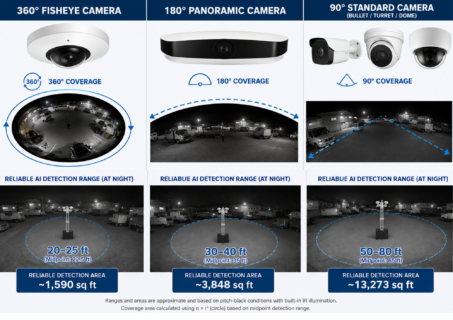
[Illustrative Jatagan field observations for commonly deployed cameras operating in complete darkness with built-in infrared and AI human-detection analytics. Actual results vary by equipment, lighting, analytics, placement, weather, and site conditions.]
7. Why Coverage-Area Calculations Can Mislead
Calculating coverage from a detection radius can make camera comparisons appear more precise than they are.
A 360° fisheye produces a circular view, a 180° camera covers a broad half-scene, and a 90° directional camera produces a narrower sector. Their detection zones have different shapes, and performance may vary between the center and edges of the image.
Real coverage also depends on mounting position, direction, terrain, structures, lighting, obstructions, and overlapping views.
More useful measurements include:
- Validated detection distance under stated conditions
- Width of the usable detection zone
- Linear perimeter footage protected
- Site-plan coverage polygons
- Nighttime test footage at the claimed distance
A square-foot total cannot show whether an important access route is protected.
For practical placement guidance, see Where 360° Security Cameras Work—and Where They Fail on Outdoor Sites.
8. How to Evaluate a Detection-Range Claim
Before accepting an advertised range, ask five questions.
1. What Does “Detection” Mean?
Does it mean motion was recorded, AI classified a person, an operator could assess behavior, or the individual could be recognized?
The range should be tied to a defined outcome.
2. Under What Conditions Was It Tested?
Ask whether the test used daylight, ambient light, built-in infrared, external infrared, visible lighting, or thermal imaging.
Also ask about weather, mounting height, background contrast, and obstructions.
3. What Equipment and Settings Were Used?
Request the camera model, resolution, sensor, lens, field of view, analytics version, sensitivity, confidence threshold, and minimum target size.
A highly sensitive setting may extend apparent range while increasing false alerts.
4. What Target Was Tested, and Where?
A vehicle is easier to detect than a person. A fully visible person is easier than someone partially blocked by fencing or equipment.
Performance may also differ between the center and outer edges of the image.
5. Can the Provider Show Actual Nighttime Footage?
Request footage recorded at the claimed distance under conditions similar to the site.
A brochure, field-of-view diagram, or daytime screenshot does not demonstrate reliable nighttime AI detection.
For an examination of a specific industry coverage claim, see Can Four Security Cameras Really Cover 360° at 150 Feet?
9. Where Long-Range Specialty Cameras Fit
Large outdoor perimeters may require systems designed specifically for extended-range detection. Effective long-range performance depends on purpose-selected sensors, specialized optics, focused illumination, analytics, stable mounting, and site-specific positioning.
Jatagan’s Range-Boosted AI Camera SystemTM is derived from its U.S.-patented Security Threat Detection technology. In suitable configurations, two Range-Boosted AI CamerasTM can protect up to approximately 1,600 feet of perimeter, including complete-darkness applications.
This is not simply another viewing-angle category. It uses different equipment, optics, illumination, and deployment objectives.
The relevant question is not:
“Which camera has the widest angle?”
It is:
“Which camera and configuration provide the required detection performance for this part of the site?”
10. Conclusion
A wider field of view produces a wider image. It does not automatically produce longer or more reliable AI detection.
A 360° fisheye may be best for overview coverage in a compact area. A 180° panoramic camera may efficiently cover a façade or loading area. A 90° directional camera may provide stronger detail along an entrance or defined approach.
The correct choice depends on the required distance, level of detail, lighting, sensor, lens, illumination, analytics, target position, and site conditions.
Before accepting a detection-range claim, require the provider to define the outcome, disclose the test conditions, and show actual nighttime performance.
Jatagan evaluates outdoor sites according to the detection zones and intervention time required—not viewing angle or camera count alone.
11. Frequently Asked Questions
Which Camera Has the Longest AI Detection Range: 360°, 180°, or 90°?
Under comparable conditions, a 90° directional camera will generally provide longer detection than a single-sensor 360° fisheye because more pixels and illumination are concentrated within a smaller area.
Camera quality still matters. A high-performance multi-sensor panoramic camera may outperform a lower-quality directional camera.
How Far Can a 360° Camera Detect a Person at Night?
There is no universal distance. In Jatagan’s field experience with commonly deployed fisheye cameras operating in complete darkness with built-in infrared, reliable AI human detection may be approximately 20–25 feet.
Results vary by model, resolution, lighting, analytics, placement, and site conditions.
Does a Higher Megapixel Count Solve the Wide-Angle Problem?
More resolution can place additional pixels across a wide scene, but megapixel count alone does not determine performance.
Sensor quality, lens, lighting, exposure, compression, analytics, and target distance also matter. A high-resolution image can still perform poorly when it is dark, blurred, obstructed, or improperly exposed.
Does Dewarping a Fisheye Image Improve Detection Range?
Dewarping can make a fisheye image easier to view, but it does not add new detail. It reorganizes the pixels captured by the sensor.
If a distant person occupies too few pixels in the original image, dewarping cannot restore detail that was never recorded.
What Is the Difference Between AI Detection and Identification?
AI detection means the analytics classified an object as a person, vehicle, or another defined target.
Identification requires enough visual detail to determine who the person is or to read a specific identifying feature. Detection can occur at a greater distance than reliable identification.