


Table of Contents
-
Introduction: Limitations Of AI-Triggered Monitoring
-
What Is AI-Triggered Monitoring?
-
The Hidden Risks of Alert-Dependent Security
-
What Makes Jatagan’s Monitoring Approach Different
-
AI-Triggered vs AI-Augmented Monitoring (Comparison Table)
-
Why Human Detection Still Matters
-
Real-World Outdoor Security Requires Layered Detection
- Final Takeaway
-
Frequently Asked Questions (FAQ)
1. Introduction: Limitations Of AI-Triggered Monitoring
Over the past few years, AI-powered security systems have rapidly gained popularity. Many providers now promote AI-triggered monitoring, promising lower costs, fewer false alarms, and fully automated protection.
But in real-world outdoor environments, this model has a critical flaw:
If the AI doesn’t generate an alert, nothing happens.
No human review.
No detection.
No intervention.
Jatagan was built specifically to address this gap.
Rather than relying on AI alerts alone, Jatagan uses AI-augmented human detection and monitoring — a layered approach that delivers more reliable security in unpredictable, real-world conditions.
2. What Is AI-Triggered Monitoring?
AI-triggered monitoring (also called alert-driven or alert-dependent monitoring) is a security model where:
-
AI algorithms analyze video feeds continuously
-
Human operators take action only after an AI alert is generated
-
If no alert is triggered, no one is watching
In this model, AI acts as the gatekeeper for all detection and response.
This approach can work in controlled environments with consistent lighting and clear lines of sight. However, most outdoor security environments are anything but controlled. Based on Jatagan’s internal data, AI-only detection systems using professional-grade equipment are typically 70–85% effective in real-world outdoor environments.
3. The Hidden Risks of Alert-Dependent Security
AI-triggered monitoring introduces several risks that are often overlooked:
Silent Detection Failures
AI systems can fail without warning due to:
-
Poor lighting or glare
-
Weather conditions (rain, fog, snow)
-
Obstructions like fences, vehicles, or equipment
-
Partial human visibility or unusual movement
When this happens, no alert is generated — and no action is taken.
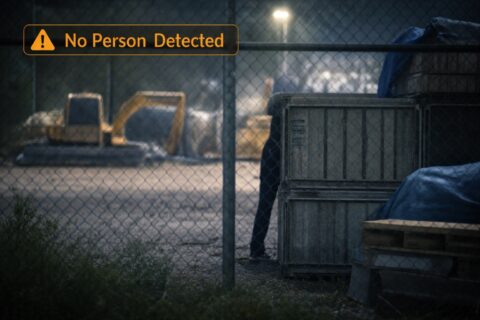
False Confidence
Organizations believe they are protected because “the AI is watching,” when in reality:
-
No human is actively monitoring
-
Missed detections go unnoticed
-
Incidents are discovered only after losses occur
Limited Context and Judgment
AI excels at pattern recognition, but struggles with:
-
Intent
-
Context
-
Unusual or novel scenarios
Security decisions often require human judgment — not just data.
4. What Makes Jatagan’s Monitoring Approach Different
Jatagan does not rely on AI as a gatekeeper.
Instead, Jatagan uses AI-Augmented HDM℠ (Human Detection & Monitoring), where:
-
AI runs continuously as an additional sensor layer
-
Trained human agents actively monitor live video feeds
-
Humans detect, interpret, and judge events in parallel with AI
This means detection does not stop when AI misses something.
AI supports humans — it does not replace them.

5. AI-Triggered vs AI-Augmented Monitoring
| Capability | AI-Triggered Monitoring | Jatagan AI-Augmented Monitoring |
|---|---|---|
| Human involvement | Only after AI alert | Continuous, active detection |
| Primary detection | AI-only | AI + human |
| Silent failure risk | High | Dramatically reduced |
| Adaptation to conditions | Requires retraining | Instant human adaptation |
| Context & intent | Limited | Strong |
| Accountability | Algorithm-dependent | Human-led |
| Best suited for | Controlled environments | Real-world outdoor security |
6. Why Human Detection Still Matters
Security is not just about seeing motion — it’s about understanding what matters.
Humans can:
-
Recognize suspicious behavior that doesn’t fit known patterns
-
Adapt instantly to new conditions or layouts
-
Detect threats AI was never trained to identify
-
Make judgment calls when visuals are incomplete or ambiguous
Even the most advanced AI models depend on historical data. Humans rely on reasoning, experience, and real-time awareness.
Jatagan’s approach ensures that humans are part of the detection layer, not just the response layer.
7. Real-World Outdoor Security Requires Layered Detection
Outdoor environments are inherently complex:
-
Changing light throughout the day
-
Seasonal weather variations
-
Construction equipment, fencing, and obstructions
-
Unpredictable human behavior
No single detection method is sufficient on its own.
That’s why Jatagan uses a layered security model:
-
AI provides scale, speed, and continuous sensing
-
Humans provide judgment, adaptability, and accountability
Together, they deliver reliable detection where AI-only systems fall short.
Jatagan doesn’t promise full automation.
We promise real protection.
8. Final Takeaway
AI-triggered monitoring depends on alerts.
Jatagan depends on detection.
By combining continuous AI monitoring with active human oversight, Jatagan delivers a more reliable, accountable, and real-world-ready security solution.
AI detects patterns.
Humans detect reality.
Jatagan delivers both.
9. Frequently Asked Questions (FAQ)
What is AI-augmented security monitoring?
AI-augmented security combines continuous AI analysis with active human monitoring. AI assists by flagging activity and reducing noise, while humans actively detect, interpret, and make decisions in real time.
How is this different from AI-triggered monitoring?
In AI-triggered monitoring, humans only respond to AI alerts. In Jatagan’s model, humans actively monitor regardless of whether an AI alert is generated.
Does Jatagan still use AI?
Yes. AI is a critical part of Jatagan’s system, but it is used as a supporting layer, not the sole detection mechanism.
Why can’t AI replace human monitoring?
AI struggles with unpredictable environments, context, and intent. Humans can adapt instantly and make judgment calls that AI cannot.
How accurate is AI-only video security in outdoor environments?
Based on Jatagan’s internal data, AI-only detection systems using professional-grade equipment are typically 70–85% effective in real-world outdoor environments. Factors such as lighting, weather, obstructions, and partial visibility can significantly reduce AI accuracy.
Is AI-augmented monitoring more expensive?
While it involves human expertise, it significantly reduces losses caused by missed detections and false confidence — often resulting in lower total risk and cost over time.
Who is Jatagan best suited for?
Jatagan is ideal for outdoor, perimeter-heavy, and high-risk sites where real-world conditions routinely challenge AI-only systems.