


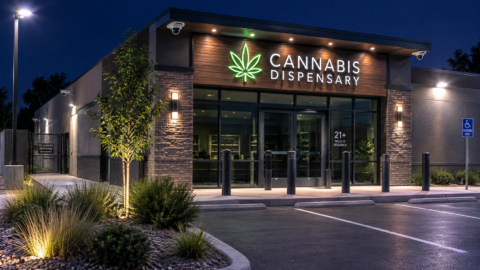
Cannabis dispensaries present a difficult security challenge. The building may be locked, the alarm armed and the inventory secured, yet the property can still be vulnerable after employees leave.
Intruders rarely approach a dispensary the same way customers do during business hours. They look for rear doors, side alleys, rooftops, utility areas and other parts of the property where they are less likely to be seen. They may spend time testing the site before attempting to enter, particularly if they believe valuable cannabis products or cash are inside.
That makes effective dispensary security about more than protecting the sales floor. The exterior of the property deserves just as much attention, especially during overnight hours when there are fewer people around to notice suspicious activity.
Table of Contents
- Why Dispensaries Require a Different Security Approach
- Vulnerability #1: Rear and Secondary Entrances
- Vulnerability #2: Roof and Upper-Level Access
- Vulnerability #3: Parking Lots and Property Approaches
- Vulnerability #4: Blind Spots Around the Building
- Vulnerability #5: Delivery and Receiving Areas
- Vulnerability #6: Cameras That Record but Do Not Prevent
- Vulnerability #7: A Security Plan That Never Changes
- Cannabis Dispensary Security at a Glance
- What to Review After an Intrusion Attempt
- Frequently Asked Questions
Why Dispensaries Require a Different Security Approach
A dispensary is not an ordinary retail store.
The combination of valuable inventory, cash exposure and public awareness of what is stored inside can make cannabis businesses attractive targets. At the same time, many dispensaries operate in buildings that were originally designed for another purpose and may have side doors, rear service areas, rooftops or neighboring properties that create security challenges.
Most customers see the front of the building. Someone considering a break-in is likely to study the entire property.
That distinction matters. A storefront may be well lit and heavily covered by cameras while the rear of the building receives much less attention. The strongest security plan considers how someone could approach the property, where that person could remain out of view and what would happen if suspicious activity were detected before an actual break-in began.
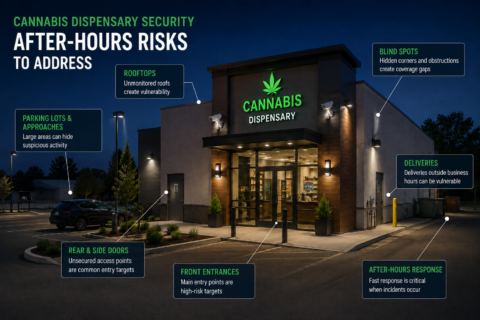
1. Rear and Secondary Entrances
The front entrance is usually one of the most controlled areas of a dispensary. It may have staff, access procedures, cameras and good lighting.
The rear door can be very different.
Service entrances, emergency exits and side doors may open onto alleys, parking areas or sections of the property with limited nighttime activity. That makes them natural areas for someone looking for a less visible way into the building.
Security cameras should cover both the door and the route someone would use to approach it. A tight camera view of the doorway may provide excellent footage once a person is already there, but it may provide very little warning beforehand.
Lighting, door hardware and physical barriers are also important, but they should work together with detection rather than independently.
2. Roof and Upper-Level Access
Dispensary security planning often concentrates on doors and windows because those are the obvious entry points.
The roof is easier to overlook.
Adjacent buildings, dumpsters, fences, utility structures and exterior ladders can sometimes provide access above ground level. Once on a roof, an intruder may have more time and concealment than someone trying to force a front or rear entrance.
Not every dispensary faces this risk, but operators should inspect the property from the outside and ask a basic question: Could someone reach the roof without attracting much attention?
If the answer is yes, cameras and intrusion detection should account for that possibility. Rooftop HVAC equipment, skylights and other openings should also be considered as part of the overall security review.
3. Parking Lots and Property Approaches
Security should begin before someone reaches the building.
Parking lots, sidewalks, driveways and neighboring areas can provide early indicators of suspicious behavior. Someone repeatedly walking around the property after hours, approaching multiple doors or lingering near a restricted area may warrant attention even though no break-in has occurred yet.
This is where wider exterior coverage can provide more value than cameras concentrated only on entrances.
California cannabis regulations also establish specific video surveillance requirements for licensed premises, including entrances and exits and areas where cannabis products are stored, loaded or unloaded. For dispensaries located in shopping centers or mixed-use properties, determining which areas can reasonably be monitored may require coordination with the landlord or neighboring tenants. The goal is not to watch every person who passes nearby. It is to have enough visibility to recognize activity that is unusual for the location and time of day.
4. Blind Spots Around the Building
Every property has geometry.
Building corners, landscaping, dumpsters, storage containers, walls and parked vehicles can create areas that are difficult to see from a fixed camera position. An intruder who studies the property may notice those areas as well.
Camera placement should therefore be evaluated from ground level, not just from a site plan.
Walk around the building after dark. Look at the actual camera views. Determine whether someone can move from the edge of the property toward a vulnerable entrance while remaining largely outside useful coverage.
Conditions also change. Trees grow, businesses add exterior storage and neighboring properties modify their layouts. A camera that provided good coverage when it was installed may not provide the same view several years later.
5. Delivery and Receiving Areas
Delivery areas combine two security concerns: movement of valuable products and access to parts of the building that customers normally do not use.
They may also operate on schedules that differ from normal retail hours.
Security planning should consider the path from the delivery vehicle to the building, where products may temporarily be staged and whether unauthorized people can approach the area unnoticed.
A receiving door that is secure when closed can still create vulnerability while employees are unloading or preparing a shipment.
Good procedures matter here as much as technology. Deliveries should follow predictable authorization processes, and staff should know what to do if an unfamiliar person, vehicle or activity appears near the receiving area.
6. Cameras That Record but Do Not Prevent
Video evidence can be valuable after an incident. It can help determine what happened, provide information to law enforcement and support an insurance claim.
But recording a break-in and preventing one are different outcomes.
If the objective is prevention, the security operation needs a way to recognize suspicious activity while it is happening and respond before the intruder reaches valuable inventory.
That response may include a live voice warning, lights, sirens, notification of designated personnel or escalation to law enforcement when appropriate.
Dispensary operators considering live video monitoring should understand exactly how the service functions. Is someone actively watching the property, or does human review occur only after an automated alert? What happens after suspicious behavior is confirmed? Who is responsible for escalating an event?
The answers matter more than simply being told that the cameras are “monitored.”
7. A Security Plan That Never Changes
Security systems tend to become part of the background once they are installed. Cameras are online, alarms are armed and the business moves on.
That can be a mistake.
Changes to the property, neighboring businesses, parking patterns or operating procedures can create new vulnerabilities. Intrusion attempts can reveal them as well.
If someone repeatedly approaches the same side of the building, tests a particular door or attempts to reach the roof, that activity provides useful information. The appropriate response is not simply to document another incident. It is to ask why that area is attracting attention and whether the security design should change.
Security should be treated as an operating process, not a one-time installation.
Cannabis Dispensary Security at a Glance
| Area | Potential vulnerability | What to evaluate |
|---|---|---|
| Front entrance | Strong daytime security but different conditions overnight | After-hours camera coverage and response |
| Rear/side doors | Lower visibility and fewer people nearby | Approach routes, lighting and detection |
| Roof | Less obvious entry route | Access points, ladders, adjacent structures and rooftop coverage |
| Parking lot | Suspicious activity may begin away from the building | Wider exterior visibility and nighttime monitoring |
| Building perimeter | Corners, vehicles and landscaping can create blind spots | Actual nighttime camera views |
| Delivery area | Valuable products and temporary access | Receiving procedures and surrounding coverage |
| Existing cameras | Good recordings but limited intervention | Monitoring method and response process |
What to Review After an Intrusion Attempt
An attempted break-in should trigger more than a police report and a repair bill.
Start by reviewing how the person approached the property. Determine when they first became visible, whether they appeared to know where cameras or entrances were located and whether anything on the property helped conceal their activity.
Then review the response.
Was the activity detected before physical damage began? Was anyone monitoring the relevant camera? Was a warning issued? Was someone notified? Did the intruder remain on site long enough to identify a weakness?
Finally, correct the specific problem that was exposed.
That might mean changing a camera angle, adding coverage, improving lighting, securing roof access or modifying the way employees use a delivery entrance. In some cases, the existing equipment may be adequate and only the security procedure needs to change.
A repeated attempt at the same location should receive particular attention. Intruders sometimes return to places where they believe they found an exploitable weakness.
For dispensaries, the objective should be straightforward: detect suspicious activity as early as practical, make the property difficult to approach unnoticed and have a clear response before an attempted intrusion turns into a loss.
Jatagan provides outdoor video security and live monitoring for commercial properties throughout Northern California, including the Sacramento region and San Francisco Bay Area. For cannabis businesses, systems are designed around the specific layout and after-hours risks of each site.
Frequently Asked Questions
1. What security risks are most common at cannabis dispensaries?
Risks vary by property, but common vulnerabilities include rear and side entrances, parking areas, delivery zones, rooftops and parts of the building perimeter with poor visibility. Valuable inventory and cash exposure can also make dispensaries attractive targets for planned break-ins.
2. Are security cameras enough to protect a cannabis dispensary?
Cameras are an important part of dispensary security, but their effectiveness depends on where they are positioned, what they can detect at night and what happens when suspicious activity occurs. Cameras that only record an event may provide evidence but do not necessarily help prevent the loss.
3. What areas should dispensary security cameras cover after hours?
Coverage should reflect the actual property. Typical areas include entrances, rear and side doors, parking lots, delivery areas, vulnerable portions of the building perimeter and any locations that could provide access to the roof.
4. What is the difference between video surveillance and live video monitoring?
Video surveillance generally refers to cameras capturing activity for live viewing or recording. Live video monitoring adds people who can assess activity remotely and take defined actions when necessary, such as issuing warnings or escalating an incident. Monitoring services can operate differently, so dispensary operators should understand exactly when human involvement begins.
5. How often should a dispensary security system be reviewed?
The system should be reviewed whenever the property or operating conditions change significantly and after any intrusion attempt. Periodic reviews are also useful for checking camera views, blind spots, lighting and whether exterior changes have affected coverage.
6. Can an existing dispensary camera system be professionally monitored?
Often, yes. Depending on camera compatibility, an existing IP camera system may be connected to a professional monitoring service without replacing every camera. A site review can determine whether the existing cameras provide adequate coverage or whether additional outdoor cameras are needed.