


Table of Contents
- Project at a Glance
- The Challenge: A 3,000-Foot Exposed Fence Line
- Why the Conventional Approach Breaks Down
- Conventional vs. Jatagan: Side-by-Side
- The Jatagan System: One Unit, Four Cameras
- Results
- What This Means for Your Site
- Frequently Asked Questions
Project at a Glance
A Costco distribution center under construction in Tracy, California needed video security for the entire site — including its longest side, a 3,000-foot fence line. That’s more than half a mile, the length of 10 football fields goal line to goal line, and conventional trailer-mounted cameras would require 6–10 surveillance towers to cover it. Jatagan Security covered the entire run with a single Solar Mobile Guard™ surveillance trailer carrying 4 Range-Boosted AI CamerasTM, with no ambient light.
| Client | Costco distribution center (under construction) |
| Location | Tracy, California |
| Scope | Full construction site security |
| Longest side | 3,000 linear feet |
| Conventional estimate | 6–10 towers, 20+ cameras for that length |
| Jatagan coverage | 1 Solar Mobile Guard™, 4 Range-Boosted AI Cameras™ |
| Monitoring | AI-Augmented DHDM℠ (Dual-Human Detect & Monitor) |
| Visibility | Full range and accuracy with no ambient light |
| Power | Solar, with battery and generator backup included |
The Challenge
Construction sites are most vulnerable before the building is finished. Materials, copper, tools, and heavy equipment sit in the open — and industry estimates put stolen construction equipment at $300 million to $1 billion per year, with fewer than 1 in 5 machines ever recovered.
Securing the Tracy site meant covering all of it — but its defining challenge is the longest side: an uninterrupted 3,000-foot fence line, road-adjacent, with clear sightlines for anyone scoping the site after hours. A run that long is where any security plan gets stress-tested, and where any security quote balloons. A video security provider whose cameras can only reach 300–500 feet has to solve it with quantity.
To put 3,000 feet in perspective: it is more than half a mile of fence. A guard walking that line covers it in roughly 12 minutes — one direction. Anyone who has priced perimeter security for a site this long knows the quote that usually follows.
Why the Conventional Approach Breaks Down
The standard playbook is to place a mobile surveillance tower every 300–500 feet of fence line, the typical reliable detection range of conventional trailer-mounted cameras. On a 3,000-foot run, that math produces 6–10 units carrying 20 or more cameras.
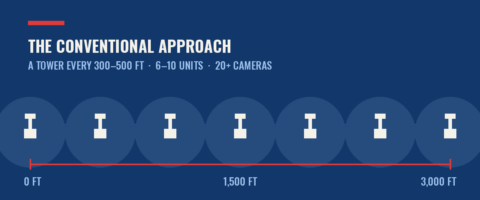
Every additional unit increases the rental invoice. Each tower needs its own power source, its own connectivity, its own maintenance visits, and its own monitoring stream. Each is a separate failure point — a dead battery or a fouled solar panel on any one of them opens a gap in the line. Cost scales linearly with distance; complexity scales with it.
Conventional vs. Jatagan
| Factor | Conventional Multi-Tower Setup | Jatagan Solar Mobile Guard™ |
|---|---|---|
| Units for 3,000 feet | 6–10 towers | 1 unit |
| Cameras | 20+ | 4 Range-Boosted AI CamerasTM |
| Power | Separate power source per tower | Solar + battery and generator backup, included |
| Failure points | 6–10 independent systems | 1 monitored system |
| Placements | A tower every 300–500 ft | One trailer for the entire 3,000 ft |
| Monitoring | 20+ separate video streams | One unit, AI-Augmented DHDMSM |
| Cost model | Scales per unit | A fraction of multi-unit cost |
The Jatagan System
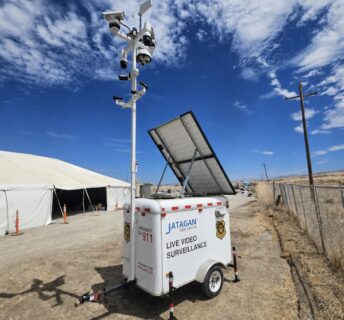
Jatagan’s approach replaces unit count with camera reach. On the 3,000-foot fence line, a single Solar Mobile GuardTM that carries four Range-Boosted AI CamerasTM on an elevated mast, is positioned so that their combined fields of view run the full length of the fence line — the run that would have taken 6–10 conventional towers.
Four elements let one unit do the work of many:
Range-boosted optics. Each AI camera is specified for long-range detection well beyond the 300–500 feet conventional trailer cameras deliver, so four cameras cover distances that would otherwise demand a fleet.
No-ambient-light performance. The cameras hold their range and detection accuracy in complete darkness, with no dependence on street lighting, site lighting, or moonlight. A fence line that goes pitch-black at night — common on an active construction site with no permanent lighting installed yet — is covered the same as it is at noon.
AI-Augmented DHDMSM (Dual-Human Detect & Monitor). The AI classifies people and vehicles rather than reacting to raw motion — filtering wind, animals, and headlights — while human operators actively detect and monitor alongside it, not just review its alerts. When an intrusion is spotted, the response is immediate, including deterrence activation and police dispatch — the unit’s job is to respond and prevent crime, not just recording.
Solar power with built-in redundancy. The unit runs on its solar array with battery storage, backed by a generator that kicks in if solar and battery ever run short — included at no extra cost to the client. No trenching for power on an active construction site and no downtime windows.
Because the entire system rides on one towable trailer, deployment took hours, not days, and the unit can be repositioned as construction phases change the site’s risk profile.
Results
The site is under live-monitored AI surveillance — including the full 3,000-foot fence line. The run that would have driven a 6–10 tower quote on its own is now covered by a single unit at a fraction of the conventional multi-unit cost. Fewer units also means a simpler chain of accountability: fewer systems to check, less to maintain, and a fraction of the failure points.
What This Means for Your Site
If your site has a long exposure — a distribution center frontage, a solar farm boundary, a laydown yard, a rail-adjacent fence — the number of towers in your last quote may say more about your vendor’s equipment than about your actual risk. Security coverage is a function of camera reach and placement, not merely unit count.
Want the math for your property? Send us your site’s linear footage and we’ll tell you what it would take — no site visit needed.
Frequently Asked Questions
1. How many mobile surveillance towers does a 3,000-foot fence line need?
With conventional trailer-mounted cameras rated for 300–500 feet of reliable detection, a 3,000-foot line typically requires 6–10 towers. With long-range AI cameras on an elevated mast, such as Jatagan’s Solar Mobile GuardTM, a single well-placed unit can cover the same distance.
2. How quickly can a mobile surveillance unit be deployed?
Because the entire system rides on one towable trailer with its own solar power, deployment takes hours, not days — no trenching, no electrical work, no fixed infrastructure. The unit can also be repositioned as construction phases change and risks shift.
3. How is the unit powered on a construction site with no utilities?
By its onboard solar array and battery storage, with a generator backup included at no extra cost for extended low-sun stretches. No trenching, no utility hookup — the unit is fully self-powered from the day it is towed into position.
4. What happens when an intruder enters the site?
Detection runs on Jatagan’s AI-Augmented DHDMSM (Dual-Human Detect & Monitor): the AI classifies people and vehicles to filter false alarms while human operators actively watch and detect in parallel. When either spots an intrusion, monitoring initiates an immediate response, including deterrence activation and police dispatch when warranted.
5. Is one unit cheaper than hiring security guards?
A single guard covering a half-mile line walks it in about 12 minutes each direction, at recurring labor cost. One solar surveillance unit watches all 3,000 feet simultaneously, at a fraction of the cost of either guards or a multi-tower camera deployment.
6. Does the system still work if the site has no lighting?
Yes. The cameras are built for no-ambient-light performance, holding full detection range and accuracy in complete darkness. Since active construction sites often have no permanent lighting installed, this matters more than daytime coverage — most attempted intrusions happen after dark.
Jatagan Security provides live video surveillance and solar mobile security units for construction sites, distribution centers, and critical infrastructure across N. California. Call (800) 896-9150 or visit jatagan.com.