


Table of Contents
- Introduction
- How Construction Site Security Typically Starts
- The Problem with Static Power Setups
- Case Study: Stanford Medicine Expansion in Redwood City
- The Jatagan Difference: Adaptive Power with Mobile Guard™ and Pole Guard
- Cost and Performance Benefits
- Comparison Table
- FAQs
- Conclusion
1. Introduction
Construction sites in the San Francisco Bay Area don’t stay the same—and neither should your security system.
Most projects begin with solar-powered surveillance units because they’re fast to deploy. But as the site evolves and power becomes available, those systems often stay unchanged—even when they’re no longer the most efficient option.
At Jatagan Security, we solve this with adaptive power construction security, allowing our systems to transition from solar to line power as the job site develops.
This approach was recently put into action at the Stanford Medicine expansion project in Redwood City.
2. How Construction Site Security Typically Starts
Early-stage construction sites usually rely on solar-powered systems because:
- There’s no existing electrical infrastructure
- Deployment needs to be immediate
- Coverage must be flexible
This makes solar the right starting point.
But it’s rarely the right long-term solution.
3. The Problem with Static Power Setups
As construction progresses, sites gain access to reliable electrical power.
However, most security setups don’t adapt.
That leads to:
- Continued reliance on higher-cost solar systems
- Missed opportunity to improve efficiency
- Equipment operating in a less optimal configuration
- Increased long-term operational costs
In fast-moving Bay Area projects, this lack of flexibility creates unnecessary inefficiencies.
4. Case Study: Stanford Medicine Expansion in Redwood City
Jatagan Security has been supporting the Stanford Medicine expansion project in Redwood City since December 2024, in partnership with Level 10 Construction.
This project involves a state-of-the-art, all-electric medical facility, with a construction environment that has continuously evolved.
What changed:
- The perimeter fence layout was reconfigured
- Site conditions shifted, impacting camera coverage
- Power availability improved as the project progressed
The challenge:
The original security plan—designed for an earlier phase—was no longer optimal.
Our approach:
We conducted a full reevaluation of the site’s protection plan, focusing on both coverage and power strategy.
- Adjusted camera positioning to eliminate blind spots
- Adapted to the new perimeter layout
- Transitioned Mobile Guard™ unit from solar to line power where feasible
The result:
- Continuous coverage
- Improved system efficiency
- 63 intrusion attempts were stopped from deployment in December 2024 through early April 2026
- Zero loss on site
This is a clear example of why security systems must evolve alongside construction sites.
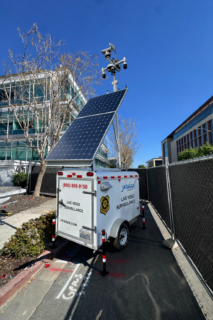
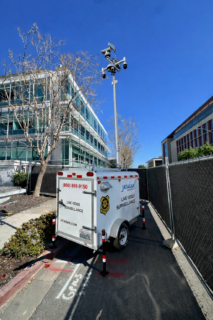
[Mobile Guard™ switching from solar to line-powered as the site evolved.]
5. The Jatagan Difference: Adaptive Power with Mobile Guard™ and Pole Guard™
Jatagan is one of the few providers offering:
Mobile Guard™ (mobile surveillance trailers) and Pole Guard™ (camera towers) systems with built-in power flexibility.
Both systems are designed to:
- Start as solar-powered deployments
- Transition to line-powered systems when available
- Maintain the same equipment and coverage footprint
Why this matters:
- No need to replace or redeploy systems
- No disruption to site security
- Power strategy evolves with the project
We call this:
Adaptive Power Construction Security
It combines:
- Rapid deployment
- Flexible coverage
- Long-term cost efficiency
6. Cost and Performance Benefits
Switching from solar to line power at the right time delivers measurable benefits:
- Lower operational costs over the life of the project
- Reduced dependence on solar hardware and maintenance
- More consistent system performance
- Better alignment with site conditions
For construction projects in the San Francisco Bay Area, this translates into smarter spending without compromising protection.
7. Comparison Table
| Feature | Solar-Only Systems | Jatagan Adaptive Power Systems |
|---|---|---|
| Initial Deployment | Fast | Fast |
| Power Type | Solar only | Solar → Line (switchable) |
| Flexibility | Limited | High |
| Cost Over Time | Higher | Optimized |
| Reliability | Weather dependent | Consistent |
| Best Use Case | Early-stage construction | Full project lifecycle |
8. Conclusion
Construction sites evolve quickly—especially in the San Francisco Bay Area.
While most security systems remain fixed in their original configuration, Jatagan takes a different approach.
With adaptive power construction security, your system can:
- Start with solar
- Transition to line power
- Maintain continuous protection
- Reduce long-term costs
The Stanford Medicine project in Redwood City is just one example of how this flexibility delivers real-world results.
9. FAQs
1. Can construction site security systems switch from solar to line power?
Most systems cannot. Jatagan’s Mobile Guard™ and Pole Guard™ systems are designed to transition between both as the site evolves.
2. Why is solar used in early construction phases?
Solar allows for rapid deployment without needing existing electrical infrastructure.
3. When should a site switch to line power?
Once reliable electrical infrastructure is available, switching to line power can reduce costs and improve performance.
4. What makes Jatagan different from other providers?
Jatagan offers adaptive power security systems that maintain mobility while allowing a transition from solar to line power—without replacing equipment.
5. Where does Jatagan operate?
Jatagan Security provides construction site security services across the San Francisco Bay Area, including Redwood City, San Jose, Oakland, and surrounding regions.