


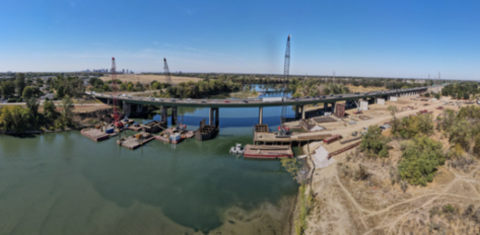
[Granite Construction’s project at the American River Bridge. Source: Business Wire]
Originally published: May 8, 2026 | Updated: October 2026
Table of Contents
- Overview of the American River Bridge Rehabilitation Project
- Security Challenges on an Active Infrastructure Site
- Jatagan’s Layered Security Strategy
- Technologies Deployed on the Project
- Final Results: 2,220 Intrusion Attempts, Zero Client Losses
- Why Dynamic Perimeter Security Matters
- Service Areas
- Frequently Asked Questions
1. Overview
Large-scale infrastructure projects present unique security challenges. Active construction zones evolve constantly, equipment and materials shift daily, and exposed perimeters create opportunities for theft, trespassing, vandalism, and liability incidents.
That was exactly the reality at the American River Bridge Rehabilitation Project in Sacramento, California — a major Caltrans infrastructure initiative led by American River Constructors (ARC), a joint venture between Granite Construction and California Engineering Contractors. The project involves replacing the bridge deck, widening the structure, improving scour protection, and adding a Class I bike and pedestrian path connecting to Sacramento’s trail system.
Over approximately 45 months, Jatagan Security protected the American River Bridge Rehabilitation Project in Sacramento, California, as construction zones, access points, and security requirements changed throughout the project.
By the completion of Jatagan’s deployment in September 2026, the results were:
- 2,220 net intrusion attempts, after excluding false alarms
- Zero successful intrusions
- Zero client losses
The completed project demonstrates how adaptable surveillance systems, proactive deterrence, and AI-augmented live video monitoring can protect a large, continuously changing construction site.
Project Video — Earlier Results
This video was produced before Jatagan’s security deployment concluded, when the project had recorded 2,194 intrusion attempts. The final count reached 2,220 net intrusion attempts, with zero successful intrusions and zero client losses.
2. Overview of the American River Bridge Rehabilitation Project
The American River Bridge Rehabilitation Project was a major infrastructure improvement initiative along State Route 51 (Business 80 / Capital City Freeway) in Sacramento, California.
The rehabilitation effort includes:
- Bridge deck replacement
- Structural rehabilitation
- Bridge widening
- Scour mitigation protection
- Traffic-shift accommodations during phased construction
- A new Class I bike and pedestrian connection
Granite Construction noted that the project includes staged bridge deck replacement and widening work to maintain traffic flow during construction.
Projects of this scale create highly dynamic security conditions that traditional static guard solutions often struggle to manage efficiently.
3. Security Challenges on an Active Infrastructure Site
Infrastructure and bridge projects are among the most difficult environments to secure.
At the American River Bridge site, security risks included:
| Security Challenge | Operational Impact |
|---|---|
| Changing work zones | Perimeters shifted constantly |
| Waterfront access points | Increased exposure and blind spots |
| High-value construction equipment | Elevated theft risk |
| Multi-phase construction | Security coverage had to evolve continuously |
| Large open site footprint | Difficult to monitor using traditional methods |
| Night operations | Higher vulnerability during off-hours |
Construction projects involving public infrastructure also face increased exposure to trespassing, unauthorized access, copper theft, and vandalism.
Because the site evolved continuously throughout the project lifecycle, security infrastructure needed to move just as quickly.
4. Jatagan’s Layered Security Strategy
To secure the site effectively, Jatagan deployed a layered security approach combining mobile surveillance technology, powerful deterrence systems, dynamic perimeter realignment, and AI-augmented human detecting and monitoring.
Rather than relying on a fixed security layout, Jatagan frequently repositioned surveillance assets as the project evolved through different construction phases.
This adaptive approach enabled continuous coverage despite changing traffic shifts, work zones, staging areas, and construction sequencing.
The strategy included:
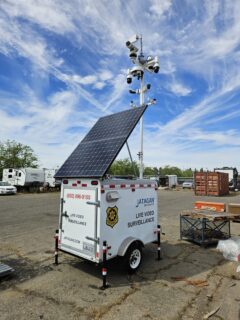
Solar Mobile Guard™ Deployment
Jatagan deployed Solar Mobile Guard™ units to provide rapid-deployment live video surveillance across active construction zones.
These units delivered:
- Autonomous solar-powered operation
- High-visibility deterrence
- Flexible relocation capabilities
- Wide-area site coverage
- Remote live video monitoring
Because the units were mobile, Jatagan could reposition coverage as site conditions changed.
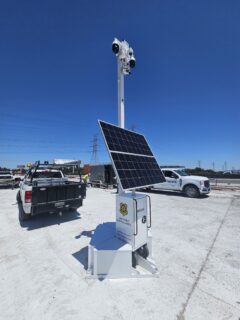
Solar Pole Guard™ Coverage
Solar Pole Guard™ systems provided elevated monitoring and perimeter visibility across critical access areas.
These deployments enhanced:
- Long-range site visibility
- Detection coverage
- Perimeter deterrence
- Monitoring of changing access routes
The elevated surveillance approach was particularly effective for large open construction environments.
Long Range Warning System
Jatagan also deployed long-range warning technology capable of issuing powerful strobe lights, sirens, voice-down warnings before unauthorized individuals reached sensitive areas.
This proactive deterrence strategy helped interrupt intrusion attempts before escalation occurred.
AI-Augmented DHDMSM (Dual-Human Detect & Monitor)
Jatagan’s AI-Augmented DHDMSM platform combined two human agents actively detecting and monitoring in parallel with advanced AI to improve threat detection and reduce missed intrusion attempts.
This technology helped identify suspicious activity while improving response accuracy across the active project environment.
5. Final Results: 2,220 Intrusion Attempts, Zero Client Losses
Metric | Final Result |
|---|---|
| Monitoring Period | Approximately 45 months |
| Net Intrusion Attempts (after excluding false alarms) | 2,220 |
| Successful Intrusions | 0 |
| Client Losses | 0 |
| Project Status | Jatagan deployment completed in 2026 |
The final results demonstrate the value of proactive security throughout a large infrastructure project. As construction advanced and security requirements shifted, Jatagan adapted its surveillance coverage to protect the changing site perimeter.
Rather than simply responding after incidents occurred, Jatagan’s layered security model focused on:
- Early detection through AI and two human monitoring agents
- Active deterrence
- Adaptive surveillance coverage
- Rapid perimeter realignment
- Continuous live monitoring during contracted monitoring hours
6. Why Dynamic Perimeter Security Matters
Many traditional construction site security programs fail because they are static.
Infrastructure projects are not static.
As projects evolve, access points shift, staging areas relocate, equipment moves, and new vulnerabilities emerge.
That’s why dynamic perimeter realignment became a critical part of the security strategy at the American River Bridge project.
Security systems needed to evolve alongside construction operations — not remain fixed while the site changed around them.
For large construction firms, infrastructure contractors, and critical infrastructure operators, adaptive security is becoming increasingly important as projects grow more complex.
7. Jatagan Security Service Areas
Jatagan Security provides construction site security, mobile surveillance, AI-augmented and human and monitoring, and live video surveillance solutions across California and beyond.
Service areas include:
- Sacramento
- San Francisco Bay Area
- San Jose
- Oakland
- Fresno
- Stockton
- Modesto
- Los Angeles
- Orange County
- Inland Empire
- Central Valley
- Northern California
- Southern California
Jatagan supports:
- Bridge rehabilitation projects
- Highway construction
- Heavy civil construction
- Infrastructure projects
- Utility construction
- Transportation projects
- Industrial sites
- Commercial construction
8. Frequently Asked Questions
Q1. What is construction site live video surveillance?
Construction site live video surveillance uses remotely monitored camera systems to detect, deter, and document unauthorized activity on active job sites.
Q2. What is a Solar Mobile Guard™ unit?
Solar Mobile Guard™ is a mobile, solar-powered surveillance platform designed for rapid deployment on active construction and infrastructure sites.
Q3. Why is layered security important for construction projects?
Layered security combines multiple technologies and monitoring methods to improve detection, deterrence, and response capabilities.
Q4. What is AI-Augmented DHDMSM?
AI-Augmented DHDMSM stands for Dual-Human Detect & Monitor — a system combining advanced AI detection with concurrent human detecting and monitoring. The goal is to eliminate missed threats due to AI limitations.
Q5. How does dynamic perimeter realignment work?
Dynamic perimeter realignment involves repositioning security assets as project phases, work zones, and site conditions evolve.
Q6. Why are infrastructure projects difficult to secure?
Infrastructure projects often involve large open perimeters, changing access points, valuable materials, public exposure, and evolving construction phases.