


Table of Contents
Introduction
Common Construction Security Challenges in Northern California
Why Construction Security Needs a Site-Specific Design
Choosing Security Equipment for Different Jobsite Conditions
Comparison Table: Construction Site Security Solutions
Why Construction Security Should Be Reviewed as the Site Changes
Frequently Asked Questions
1. Introduction
Construction sites in Northern California face security conditions that can change throughout the life of a project. Valuable equipment and materials may remain outdoors after hours, temporary fencing can create weak points, and new structures or equipment can block camera views that were clear earlier in the job.
Urban construction sites in the San Francisco Bay Area may also contend with dense surroundings, public access and limited space, while larger Sacramento-area projects can have long perimeters and remote sections of property to protect.
Understanding these site-specific challenges is the first step toward designing security that remains effective as the project changes.
For Jatagan’s construction security services in Sacramento and the San Francisco Bay Area, see our construction site security solutions.
2. Common Construction Security Challenges in Northern California
Construction site security in Sacramento and the San Francisco Bay Area presents unique challenges:
Large, open construction zones with changing layouts
High-value construction materials and heavy equipment
Limited access to permanent power or internet
Urban job sites near public streets and foot traffic
Traditional CCTV and fencing can provide useful protection, but they may be limited if suspicious activity is only recorded rather than detected and addressed while it is occurring. Modern construction site security requires real-time monitoring, intrusion detection, and active deterrence to stop theft and vandalism as it happens.
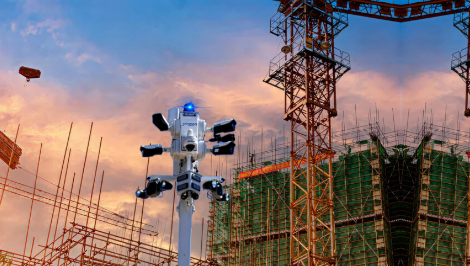
3. Why Construction Security Needs a Site-Specific Design
No Two Construction Sites Are the Same
Construction projects vary in size, duration, layout, access, power availability and risk. A system that works well on a large open property may be poorly suited to a dense urban jobsite with limited space and frequent public activity.
Security design should therefore begin with the property itself: where people are likely to enter, what needs protection, how far cameras need to see and which parts of the site are likely to change as construction progresses.
Jatagan provides construction security throughout Northern California, including large commercial sites in the Sacramento region and dense urban projects in the San Francisco Bay Area.
4. Choosing Security Equipment for Different Jobsite Conditions
Construction sites do not all need the same type of security equipment.
A large, open property with a long perimeter may require a very different setup from a dense urban project with limited space, narrow access points and nearby public activity. Power availability, site layout, camera sight lines and how frequently the jobsite changes should all influence the design.
For open or remote sites, deployable surveillance systems can provide flexible coverage without requiring permanent infrastructure. On tighter sites, compact camera towers or mounted systems may fit better around buildings, fences and active work areas.
Additional cameras may also be needed as the project evolves. New structures, stored materials, trailers or equipment can block views that were clear earlier in the job. A system that worked during site preparation may need to be adjusted during structural work, MEP installation or finish-out.
Rather than choosing equipment by product type alone, contractors should evaluate:
- how much perimeter needs to be covered;
- whether reliable power and internet are available;
- how far cameras need to detect activity at night;
- whether equipment can be relocated as the site changes;
- where high-value materials or machinery will be stored;
- which areas are most likely to become blind spots.
Jatagan uses different outdoor video security configurations depending on the site, including Mobile GuardTM, Pole GuardTM, Mounted GuardTM and Satellite GuardTM systems. These factors help determine whether a site is better suited to a deployable trailer, compact camera tower, mounted cameras, supplemental satellite cameras or a combination of systems.
5. Comparison Table: Construction Site Security Solutions
Jatagan’s four outdoor security systems are designed for different site conditions, power availability and coverage requirements:
| Security solution | Best use case | Primary advantage |
|---|---|---|
| Mobile surveillance trailers | Large, open construction sites | High-capacity deployable coverage |
| Camera tower systems | Urban sites and remote properties | Compact, flexible deployment |
| Mounted security cameras | Sites with available structures or power | Permanent or semi-permanent coverage |
| Satellite camera systems | Complex sites with isolated blind spots | Extends coverage without another full unit |
6. Why Construction Security Should Be Reviewed as the Site Changes
Construction sites do not stay static. New structures go up, equipment moves, access points change, and materials arrive at different stages of the project. Those changes can create new blind spots or make an earlier security design less effective.
A camera that had a clear view during site preparation may be partially blocked once framing, containers or equipment are in place. A remote area that was low risk early in the project may become more important when copper, fixtures or other valuable materials arrive.
Security reviews should therefore be tied to meaningful changes on the jobsite rather than treated as a one-time setup. Contractors should periodically check:
- whether camera views are still clear;
- whether new access points have appeared;
- whether high-value materials have moved;
- whether repeated intrusion attempts are occurring in the same area;
- whether the current equipment still matches the layout and risk.
An attempted intrusion can also provide useful information. If people repeatedly approach the same fence line, gate or corner of the property, that may indicate a weakness worth correcting before a loss occurs.
Jatagan provides construction site security throughout Northern California, including the Sacramento region and San Francisco Bay Area, with systems designed around each project’s layout, perimeter and changing conditions.
7. Frequently Asked Questions
Why do construction security needs change during a project?
Construction sites change constantly. New structures, equipment, materials and access points can create blind spots or shift risk to different areas. Security should be reviewed as the project progresses so camera coverage, perimeter protection and monitoring continue to match current site conditions.
What are the biggest security risks at construction sites?
Common risks include theft of tools, equipment and materials, vandalism, trespassing, unauthorized access and weak points along temporary fencing or secondary entrances. Risk can increase when valuable materials arrive or when work areas move farther from active personnel.
How often should construction camera coverage be reviewed?
Camera coverage should be reviewed after major site changes and periodically on longer projects. New buildings, containers, equipment and temporary structures can block views that were clear when the system was first installed.
What causes blind spots on construction sites?
Blind spots can be created by trailers, equipment, stored materials, temporary buildings, new structures, fencing changes and poor camera placement. Because these conditions change over time, camera views should be checked from the actual site rather than assumed to remain effective.
How can off-grid construction sites be monitored?
Off-grid sites can use surveillance systems with solar power, battery storage, wireless connectivity and backup power. The system should be designed around local sunlight, cellular coverage, site layout and the amount of camera and monitoring equipment required.
When should construction security equipment be relocated?
Equipment should be considered for relocation when camera views become obstructed, high-value materials move, access points change or intrusion activity shifts to another part of the property. Moving equipment can be more effective than simply adding more devices.