


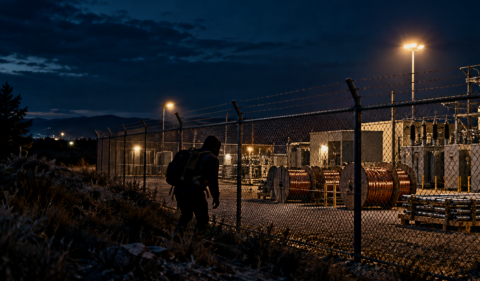
Copper theft is more than a property-loss problem. The FBI has identified resource-metal theft, including copper theft, as a threat to critical U.S. infrastructure because it can disrupt power, communications and emergency services.
For property owners, contractors and facility managers, the challenge is that copper can disappear quickly. Wire, HVAC components, electrical equipment and stored cable may be removed or damaged in a short period of time.
The best defense starts well before someone reaches the asset.
Effective copper theft prevention combines basic physical security with thoughtful camera placement, equipment capable of working at the required distance and lighting conditions, active monitoring and a clear response plan. Just as important, the security provider should be able to show how its approach performs in actual deployments.
Quick answer: To prevent copper theft, make the site harder to enter, protect likely approach routes, use cameras that can detect people at the required distance and at night, and make sure the monitoring process can still identify an intrusion if AI does not generate an alert.
Table of Contents
- Start With Basic Physical Security
- Design Protection Around the Site
- Make Sure Cameras Can See Far Enough at Night
- Understand How the Monitoring Actually Works
- Look for Documented Performance
- Copper Theft Case Study: What Failed and What We Changed
- What to Ask a Security Provider
- Frequently Asked Questions
1. Start With Basic Physical Security
Before adding technology, make the site less inviting and the copper harder to reach.
Where practical, keep loose copper, cable and other valuable materials in locked storage. Maintain fencing and gates, control access to the property and avoid storing high-value material close to public streets or lightly protected perimeter areas. Good lighting can also reduce secluded spaces around equipment and storage.
These measures are useful because they add time and difficulty to a theft.
But they have limits. A fence can be cut. A lock can be defeated. Lighting may make an intruder easier to see, but someone still has to notice what is happening.
Physical barriers work best when they give the security system more time to detect and respond.
2. Design Protection Around the Site
Buying good cameras does not automatically produce good coverage.
The more important question is where those cameras are placed.
Copper is rarely spread evenly around a property. Electrical panels, HVAC units, transformers, cable reels and stored materials may be concentrated in only a few areas. An intruder, meanwhile, may approach from a fence line, a neighboring property, a dark corner or an area partially blocked by equipment.
A good outdoor video security design starts with the site itself.
The provider should look at:
- where the most valuable or vulnerable copper is located;
- likely entry and exit routes;
- camera distance and viewing angle;
- fences, containers, equipment or structures that may obstruct the view;
- how the site may change over time.
That last point is especially important on construction sites. Materials arrive. Buildings go up. Trailers move. Heavy equipment gets parked in different places.
A camera view that works well in June may not provide the same coverage in September.
Camera placement determines what the system has an opportunity to detect. That is why protection design should be based on actual site conditions rather than a standard equipment package.
3. Make Sure Cameras Can See Far Enough at Night
Copper theft often happens after normal work hours, when a property is quiet and poorly lit.
At that point, camera capability matters as much as camera location.
A camera can technically show an entire fence line without providing enough usable detail to reliably detect a person at the far end of that view. Distance, darkness, viewing angle and partial obstruction all affect what the system can see.
When evaluating copper theft security, ask a practical question:
Can the system detect a person where the intrusion is likely to begin?
On a small property, that may be relatively easy.
On a large construction, industrial or utility site, a person may first appear hundreds of feet from the equipment or materials being protected. The system may need to identify someone at a remote fence line in very low light or total darkness.
Jatagan developed its Range-Boosted AI Camera SystemTM for large outdoor environments where long-distance detection in total darkness is important.
The point is not simply to cover more acreage. It is to identify suspicious activity while there is still time to act.
If the first useful image appears only after someone is cutting cable or opening an HVAC unit, the response is already late.
4. Understand How the Monitoring Actually Works
This is one of the most important differences between video security providers.
Many monitoring services use AI to analyze camera feeds. When the software detects a person or another defined event, it creates an alert. A human operator then reviews the video and decides whether action is needed.
That process can work well when an alert is generated.
But outdoor AI detection is not perfect.
Lighting changes. Rain, fog, glare and shadows affect the image. Equipment or vegetation may partially obscure a person. At long distances, the subject may occupy only a small portion of the camera view.
So buyers should ask another question:
What happens when the AI does not generate an alert?
In an alert-dependent model, the human operator may never receive the event for review.
No alert can mean no response.
Jatagan uses AI-Augmented DHDMSM, or Dual-Human Detect & Monitor. AI works alongside two trained human monitoring agents who watch the same video feeds concurrently rather than simply waiting for AI-generated alerts.
The purpose is redundancy. Because AI can miss an event, the two human detection layers help reduce the chance that an intrusion goes unnoticed.
That matters with copper theft because the useful response window can be short. Ideally, suspicious activity is recognized while someone is still approaching or entering the protected area—not after material has already been removed.
5. Look for Documented Performance
Camera specifications can tell you a great deal about the equipment.
They do not tell you how often the complete security operation actually prevents a loss.
When comparing providers, ask how they measure performance. Do they track genuine intrusion attempts? Do they track misses? Are false alarms separated from real events? Is the same calculation method used consistently?
Jatagan publishes a 12-month rolling 99.9%+ Crime Prevention Success Rate. The calculation uses documented intrusion attempts and misses, with false alarms excluded.
UL Solutions independently verified Jatagan’s Security Incident Performance Reporting and Calculation Process used to calculate the published Crime Prevention Success Rate. The verification applies to the reporting and calculation process, rather than to an individual monthly performance number. Jatagan was the first company in the security industry to receive this verification.
For a buyer, that provides another way to evaluate a security provider: not only by what the system is designed to do, but by how the provider measures what actually happens in the field.
6. Copper Theft Case Study: What Failed and What We Changed
A real incident at a critical-infrastructure construction project for SMUD in Sacramento shows why these details matter.
In early November 2025, intruders entered through a fence line near the far edge of the existing camera views. At that distance and angle, the AI tripwire did not flag them at the fence.
Jatagan’s monitoring agents later detected the intruders after they had entered the property and initiated deterrence and escalation. During the delay in onsite response, copper was stolen from HVAC condenser units.
The incident revealed a specific weakness at that entry point.
Jatagan changed the escalation protocol and installed a dedicated, zoomed-in hot-spot camera covering the vulnerable fence line. The new view made people larger and clearer at the location where the earlier intrusion had occurred.
Jatagan reports no further issues following those changes.
The takeaway was not that every site needs another camera. It was that security design should adapt when conditions or actual incidents reveal a weakness.
That is particularly relevant on construction sites, where the environment can change significantly over the course of a project.
7. Copper Theft Prevention: What to Ask Your Security Provider
| What to evaluate | Why it matters | Question to ask |
|---|---|---|
| Physical security | Fencing, access control and secure storage can make theft more difficult. | What physical vulnerabilities should be addressed first? |
| Site design | Poor angles or uncovered approaches can create weak points. | How will you identify and cover the highest-risk areas? |
| Night detection | Intrusions often occur when the property is dark and unoccupied. | How far can your cameras reliably detect a person at night? |
| Monitoring model | Some monitoring depends on AI creating the initial alert. | What happens if the AI does not detect the event? |
| Deterrence and response | Seeing an intruder is only the beginning. | What happens after suspicious activity is detected? |
| Performance measurement | Equipment specifications alone do not show actual results. | Do you track misses as well as successful interventions? |
A good proposal should make these answers clear. The objective is not to buy the longest equipment list; it is to understand how the proposed protection will work at your particular property.
Frequently Asked Questions
1. What is the best way to prevent copper theft?
The best approach combines physical barriers, secure storage, site-specific camera coverage, reliable night detection, live monitoring, active deterrence and a defined response process. The security plan should reflect where the copper is located and how someone is most likely to approach it.
2. Can security cameras prevent copper theft?
Security cameras can help prevent copper theft when they are part of an active security system. Recording alone documents what happened. Real-time detection, live video monitoring, deterrence and escalation allow action to begin while the intrusion is still underway.
3. How do you prevent copper theft at a construction site?
Secure copper and other valuable materials where practical, maintain fences and gates, control site access and avoid leaving high-value material exposed near lightly protected areas. Video security should cover likely entry routes as well as the assets themselves. Because construction sites change, camera coverage should also be reviewed as buildings, equipment and stored materials move.
4. Can AI video monitoring miss an intruder?
Yes. Outdoor AI detection can be affected by lighting, weather, distance, viewing angle, obstruction and partial visibility. Jatagan uses AI-Augmented DHDMSM so two trained human agents monitor the same video feeds alongside AI rather than relying solely on AI-generated alerts.
5. What should I ask a security provider about copper theft?
Ask how the site will be surveyed, which areas are considered most vulnerable, how cameras perform at night and at distance, how monitoring works if AI fails to create an alert, what deterrence and escalation methods are available, and whether the provider measures actual prevention performance.