


Table of Contents
-
Overview
-
What Went Wrong at the Louvre
-
How Jatagan Security Would Have Stopped It
-
Key Advantages of Jatagan’s Approach
-
From Art Museums to Job Sites — The Same Lesson
-
Final Insight
-
Frequently Asked Questions (FAQ)
Overview
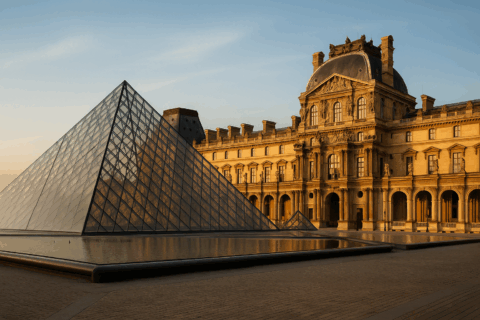
On October 19th 2025, the world’s most visited museum — the Louvre in Paris — became the scene of a daring art theft. A team of thieves used a stolen lift truck to enter an upper-floor window of the Galerie d’Apollon and stole eight French Crown Jewels in less than seven minutes. The Louvre Museum Heist is a wake-up call for outdoor security.
Despite having internal alarms and cameras, the Louvre’s perimeter security failed. Outdoor surveillance was incomplete, and cameras missed critical exterior zones. Investigators later called it a “chronic underestimation of intrusion risk.” The lesson is clear: true protection begins outside the walls.
What Went Wrong at the Louvre
Authorities discovered that alarms sounded only after entry. The museum’s external cameras were outdated or poorly placed, and blind spots allowed the thieves to operate unseen. Their escape was so swift that response teams arrived only after the jewels were gone.
The takeaway? Even the most iconic landmarks are vulnerable without robust outdoor video security — the first line of defense every site needs.
How Jatagan Security Would Have Stopped It
Jatagan Security, a leader in outdoor video surveillance and live deterrence, builds systems designed exactly for this scenario. With more than 20 years of expertise, Jatagan’s AI-powered, real-time, redundant monitoring prevents intrusions before they happen — not after.
Key Advantages of Jatagan’s Approach
| Lesson from Louvre | Weakness Exposed | Jatagan’s Solution |
|---|---|---|
| Thieves entered via façade window despite alarms | Unmonitored perimeter and poor outdoor coverage | Mobile Guard™ and Pole Guard™ systems provide 360° outdoor video monitoring of all approach routes and access points |
| Fast operation — 7 minutes from entry to exit | Alarms triggered but no live response | 24/7 live monitoring and intervention with sirens, lights, and audio warnings |
| Use of lift truck to reach upper level | No detection of large vehicle activity | AI-based vehicle analytics alert security when unauthorized vehicles or lifts enter the area |
| Camera blind spots and visibility gaps | Incomplete coverage planning | Custom site mapping and perimeter audits eliminate outdoor blind zones |
From Art Museums to Job Sites — The Same Lesson
Whether it’s a museum, construction site, energy facility, or storage yard, the principle is identical: your perimeter is your protection. Indoor cameras capture events; outdoor systems prevent them.
Jatagan’s outdoor-first philosophy uses weatherproof mobile surveillance trailers, pole-mounted units, and real-time AI analytics to detect and deter threats where they begin — outside.
Final Insight
The Louvre Museum heist wasn’t a failure of technology — it was a failure of preparation. Even world-class institutions can overlook the weakest link: the exterior.
With AI-driven outdoor surveillance, proactive deterrence, and live monitoring, Jatagan Security delivers what the Louvre needed most — eyes on the outside.
Protect your perimeter. Prevent the next Louvre.
Frequently Asked Questions (FAQ)
Was the Louvre heist really preventable with better outdoor security?
Yes. The incident highlights a common vulnerability: perimeter blind spots and delayed response. Even with internal alarms and cameras, threats can succeed when exterior monitoring is incomplete and response is reactive rather than proactive.
What does “outdoor-first security” mean in practice?
Outdoor-first security means detecting and deterring intrusions before someone reaches the building. Instead of relying on indoor alarms after entry, the perimeter is treated as the primary defense layer—covering approach routes, access points, and exterior elevations.
Why didn’t the Louvre’s internal alarms stop the theft?
According to the account provided, alarms only sounded after entry, and the thieves completed the theft and escape before response teams arrived. That’s a classic problem with indoor-only protection: it documents events after they begin, rather than preventing them.
How would Jatagan’s system respond differently to a fast “in-and-out” theft?
Jatagan’s approach is designed to detect threats early and apply deterrence immediately. With 24/7 live monitoring and intervention tools (sirens, lights, audio warnings), the objective is to stop the intrusion while it’s still outside—or disrupt it as soon as the perimeter is breached.
Would Jatagan’s AI analytics detect something like a lift truck used for entry?
Yes. AI-based vehicle analytics can flag large vehicle movement, unauthorized vehicle activity, and unusual patterns (such as a lift truck approaching a façade or restricted zone). This creates earlier alerts and enables faster intervention.
How does Jatagan reduce blind spots that traditional camera setups miss?
Jatagan eliminates coverage gaps through site mapping, perimeter audits, and placement planning that prioritizes approach routes, elevation access points, and likely intrusion paths. The goal is full exterior visibility—not partial coverage.
Is this relevant outside of museums?
Absolutely. The same security failure applies to construction sites, energy facilities, storage yards, remote industrial operations, and any property with valuable assets. The core lesson is universal: if the perimeter is weak, everything inside is exposed.
What’s the biggest takeaway from the Louvre incident?
Indoor cameras capture events; outdoor systems prevent them. The most critical security layer isn’t what happens after entry—it’s what happens before entry.