


Table of Contents
- Introduction
- The Industry Standard: Solar-Only Surveillance
- The Core Problem: Static Systems in Dynamic Environments
- A New Model: Lifecycle-Adaptive Surveillance
- Real-World Example: Stanford Medicine Expansion Project
- The Three Structural Advantages of Jatagan’s Approach
- Key Takeaways
- FAQs
1. Introduction
Solar-powered surveillance systems have become the default choice for securing construction sites, residential subdivisions, and remote environments—particularly in high-growth regions like Sacramento and San Francisco Bay Area, where construction site security and rapid deployment are critical. They are fast to deploy and require no existing infrastructure—making them ideal for early-stage projects.
But deployment is only the beginning.
As sites evolve, many organizations encounter a costly reality: most solar-powered surveillance systems are designed for a single phase—not the full lifecycle of a project.
The result is a disconnect between how systems are designed and how real-world environments evolve—ultimately driving up costs for clients.
Jatagan takes a different approach—one that focuses not just on the start-up phase, but on long-term performance and total cost efficiency.
2. The Industry Standard: Solar-Only Surveillance
Most surveillance providers offer solar-only mobile security units. These systems are designed to be:
- Self-contained
- Easy to deploy
- Independent of grid power
This simplicity comes at a cost.
Because they are fixed systems, they:
- Depend on consistent sunlight
- Cannot transition to line power
- Remain locked into their original configuration
Solar-only systems solve the problem of getting started—but not the problem of what happens next.
3. The Core Problem: Static Systems in Dynamic Environments
Real-world environments change constantly:
- Construction sites evolve
- Buildings rise and create shade
- Perimeters shift
- Power infrastructure is introduced
A surveillance system that cannot adapt becomes inefficient—or even ineffective.
This is the core limitation of solar-only surveillance:
It is a static solution applied to a dynamic environment.
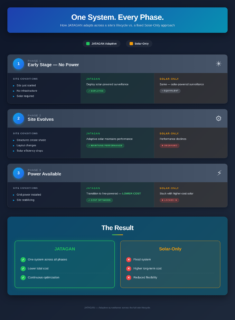
4. A New Model: Lifecycle-Adaptive Surveillance
Jatagan approaches security differently.
Instead of treating surveillance as a fixed deployment, Jatagan designs systems that adapt across the full lifecycle of a project.
This includes:
- Deploying solar when power is unavailable
- Transitioning to line power when infrastructure is introduced
- Maintaining uninterrupted monitoring throughout
This model aligns security with how sites actually operate—over time, not just at the start.
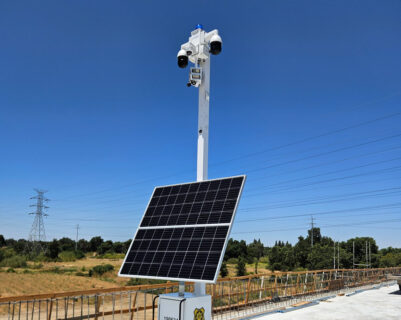
[Solar Pole Guard™ deployed in early-stage development with no existing infrastructure.]
5. Real-World Example: Stanford Medicine Expansion Project
Jatagan’s deployment at the Stanford Medicine expansion project in Redwood City, CA—one of many projects supported across the Bay Area and Sacramento regions—demonstrates this approach in practice.
Initial deployment:
- Early-stage construction site
- Solar-powered Mobile Guard™ unit installed
As the site evolved:
- Perimeter changed
- Camera performance was impacted
- Solar-only systems would have become less viable
Jatagan’s approach:
- Reconfigured the system from solar-powered to line-powered
- Redesigned coverage based on updated site conditions
- Maintained continuous surveillance
Results:
- 63 intrusion attempts were stopped from deployment through early April 2026
- Zero loss since deployment (Dec 2024)
This demonstrates a key principle:
The most effective surveillance systems are not fixed—they evolve. This deployment reflects a common challenge faced by organizations across both the Bay Area and Sacramento, where evolving site conditions demand more than static surveillance systems.
6. The Three Structural Advantages of Jatagan’s Approach
I. Adaptive Solar Power System™
Reliable Power Without Operational or Labor Overhead
Most solar-powered surveillance systems require ideal sunlight. When conditions change, teams often need to:
- Reposition equipment
- Add supplemental power
- Accept reduced performance
Jatagan’s Adaptive Solar Power System™ is designed for low-light and shaded environments, maintaining consistent power delivery for 24/7 monitoring.
Operational impact:
- Reliable performance in real-world conditions
- Flexible unit placement based on optimal security needs—not sunlight
Cost impact:
- Eliminates labor and downtime from repositioning units
- Reduces need for supplemental or temporary power solutions
II. Hybrid Power Capability
Lower Cost Over Time with Seamless Transition to Line Power
Solar-only systems are fixed. When grid power becomes available, they:
- Cannot convert
- Continue to incur the higher cost of solar for the duration of the project
Jatagan systems are designed to:
- Start as solar-powered when needed
- Transition to line-powered as infrastructure becomes available
- Continue operating without replacement
Importantly, line-powered operation is typically less expensive than solar over time.
Operational impact:
- Continuous optimization as site conditions evolve
- No disruption to surveillance coverage
Cost impact:
- Avoids full system replacement
- Enables transition to lower-cost line power
- Maximizes ROI
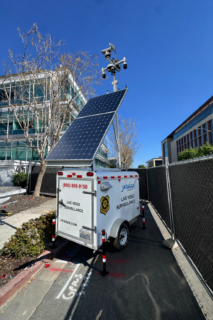
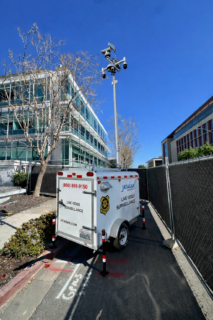
[Mobile Guard™ – from solar to line-powered as site conditions evolved.]
III. Built-In Backup Power
No Hidden Fees, No Downtime Risk
Backup power is essential—but often excluded from solar surveillance packages.
Many providers:
- Charge extra for generators
- Introduce ongoing operating costs
Some methane fuel cell generators cost as much as $1,000 per month.
Jatagan includes:
- Backup generator
- Battery systems
- Full redundancy
Operational impact:
- Continuous uptime regardless of weather or conditions
- Reduced risk of surveillance gaps
Cost impact:
- No additional fees for backup generator
- Predictable, all-in pricing
Solar-Only vs Adaptive Surveillance Systems
| Capability | Solar-Only Surveillance Systems | Jatagan Adaptive System |
|---|---|---|
| Deployment without grid power | ✔ Yes | ✔ Yes |
| Works in shaded environments | ✖ Limited | ✔ Yes (Adaptive Solar Power System™) |
| Converts to line power | ✖ Not possible | ✔ Seamless transition |
| Adapts to changing site conditions | ✖ No | ✔ Yes |
| Backup generator included | ✖ Often extra cost | ✔ Included |
| Long-term cost efficiency | ✖ Higher (fixed solar costs) | ✔ Lower (line power transition) |
| System lifecycle coverage | ✖ Initial phase only | ✔ Full project lifecycle |
7. Key Takeaways
Most solar-powered surveillance systems prioritize project startup—not long-term cost efficiency.
Jatagan introduces a different model—one that aligns with both real-world conditions and total cost efficiency:
- Adaptive solar power enables reliable performance even in shaded environments
- Hybrid power flexibility allows transition to lower-cost line power over time
- Built-in backup systems eliminate hidden costs and downtime risks
This approach ensures that security systems don’t just work at the start of a project—they continue to perform and optimize over time.
Final Thoughts
The limitation of most surveillance systems is not solar—it is inflexibility.
Jatagan’s approach is built on a different principle:
Design systems that adapt, optimize, and reduce cost over time.
Because in real-world environments, the best system isn’t the one that works on day one—it’s the one that keeps working as everything else changes.
Jatagan supports projects across the San Francisco Bay Area and Sacramento, delivering adaptive, fully integrated surveillance systems designed for real-world conditions.
8. FAQs
1. Why can’t most solar surveillance systems convert to line power?
Because they are designed as fixed, self-contained units without hybrid capability.
2. Is solar or line-powered surveillance cheaper?
Solar is useful for early phase of a project, but line-powered systems are typically more cost-effective long-term. Jatagan allows seamless transition between both.
3. Can Jatagan systems work in shaded areas?
Yes. The Adaptive Solar Power System™ is designed for low-light and shaded environments.
4. Are backup generators included?
Yes. Jatagan includes backup power as part of the solar package—no additional cost.
5. What is the most cost-effective surveillance solution for construction sites in the Bay Area and Sacramento?
Solar-powered surveillance systems are useful for early-stage deployment when no power infrastructure exists. However, for most projects in the San Francisco Bay Area and Sacramento, the most cost-effective approach is a system that can transition from solar to line power over time. Jatagan’s hybrid surveillance systems are designed for this flexibility—allowing clients to reduce long-term costs while maintaining continuous security coverage.
6. What industries benefit most from this approach?
- Construction
- Residential subdivisions
- Industrial facilities
- Infrastructure projects
- Vacant properties
- Remote operations