


Businesses invest in video security to prevent theft, vandalism, trespassing, and property damage. Yet many organizations continue to suffer losses despite having cameras, monitoring services, and security technology in place.
Why?
Because not all video security companies are built to achieve the same outcome.
Some providers focus primarily on documenting incidents. Others rely heavily on AI-driven monitoring to improve efficiency and scalability.
The highest-performing providers take a different approach: they combine intelligent system design, multi-layered threat detection, and advanced security technology to stop incidents before losses occur.
Understanding these differences helps explain why some video security companies consistently achieve superior crime prevention results.
Table of Contents
- Why Some Video Security Companies Struggle to Prevent Crime
- How High-Performing Video Security Companies Achieve Better Results
- Pillar 1: Site-Specific Security Planning
- Pillar 2: Multi-Layered Detection Through Simultaneous AI and Human Monitoring
- Pillar 3: Advanced Security Technology
- The Three-Pillar Formula for Crime Prevention Success
- Frequently Asked Questions About Video Security and Crime Prevention
1. Why Some Video Security Companies Struggle to Prevent Crime
For years, remote video monitoring relied on human operators who actively watched live camera feeds and responded when suspicious activity occurred.
While reasonably effective, this model was labor-intensive and difficult to scale.
The introduction of artificial intelligence transformed the industry. AI-powered monitoring enabled providers to automate threat detection, reduce labor costs, and manage significantly more cameras.
Today, many monitoring centers operate using an AI-first model.
When AI detects suspicious activity, operators respond.
When AI misses suspicious activity, no alert is generated, no operator is notified, and no response occurs.
These missed detections are often invisible because the system never recognizes the threat in the first place.
This challenge becomes particularly significant in outdoor environments where darkness, weather, fencing, equipment obstructions, and complex backgrounds can affect detection performance.
Based on Jatagan’s internal monitoring data across thousands of outdoor deployments, AI-only monitoring systems can miss approximately 15-30% of real-world outdoor threats under challenging conditions.
The highest-performing video security companies recognize that effective crime prevention requires more than a single detection layer.
2. How High-Performing Video Security Companies Achieve Better Results
The most successful remote video monitoring companies consistently excel in three areas:
- Site-specific security planning that eliminates blind spots.
- Simultaneous AI and human monitoring that reduces missed detections.
- Advanced security technology that improves coverage, reliability, and cost efficiency.
Together, these capabilities create a proactive security strategy that goes beyond one-size-fits-all deployments, single-layer detection, and conventional security technology.
3. Pillar 1: Site-Specific Security Planning
Even the best monitoring team cannot protect areas that cameras cannot see.
That’s why effective crime prevention begins with proper system design.
Every property presents different security challenges. A downtown construction site has different risks than an industrial yard, utility substation, logistics facility, or vacant property.
Yet many providers deploy one-size-fits-all security units with nearly identical camera configurations regardless of site conditions.
The result is often:
- Blind spots
- Poor perimeter visibility
- Unprotected access points
- Limited nighttime coverage
High-performing video security companies begin with a comprehensive site assessment that evaluates:
- Property size and layout
- Perimeter complexity
- Lighting conditions
- Power availability
- Connectivity requirements
- Site-specific vulnerabilities
Only after understanding the environment should a monitoring strategy be developed.
The principle is simple:
If a threat cannot be seen, it cannot be stopped.
Coverage is the foundation of crime prevention.
4. Pillar 2: Multi-Layered Detection Through Simultaneous AI and Human Monitoring
Once proper coverage is established, detection reliability becomes the next critical factor.
Many providers rely primarily on AI-generated alerts. While AI is an extremely valuable tool, making it the sole gatekeeper of threat detection introduces risk.
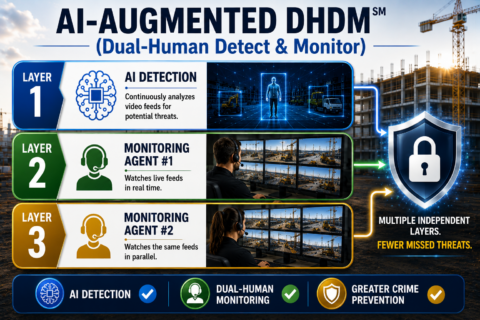
Jatagan’s AI-Augmented DHDMSM (Dual-Human Detect & Monitor) was designed to address this challenge.
Instead of relying solely on AI, DHDMSM combines AI analytics with two trained monitoring agents who actively monitor the same camera feeds in parallel.
All three detection layers operate simultaneously.
| Detection Layer | Function |
|---|---|
| AI Detection | Continuously analyzes video for potential threats |
| Human Agent 1 | Actively monitors live video feeds in real time |
| Human Agent 2 | Simultaneously monitors the same feeds in real time |
This creates multiple independent opportunities to identify a threat.
If AI detects suspicious activity, both agents can immediately assess and respond.
If AI misses a threat, either human agent can still identify it.
If one agent overlooks an event, the other may still detect it.
Rather than relying on a single point of failure, DHDMSM creates a multi-layered defense system designed to reduce silent misses and improve detection reliability.
The result is stronger crime prevention performance and greater protection for customers.
5. Pillar 3: Advanced Security Technology
Effective crime prevention requires more than monitoring. It also requires technology that can see farther, operate reliably, and protect large outdoor environments cost-effectively.
High-performing video security companies invest in advanced security technology that improves coverage, increases reliability, and reduces deployment costs.
One example is perimeter protection. Traditional perimeter security systems often require multiple cameras to secure long distances, increasing equipment, installation, and maintenance costs. Jatagan’s Range Boosted AI Camera SystemTM can protect up to 1,600 feet of perimeter in total darkness using just two cameras—a distance longer than five football fields. By comparison, conventional perimeter deployments may require eight or more cameras to achieve similar coverage.
Reliable power is equally important. Many outdoor security systems struggle in shaded or low-light environments where traditional solar-powered solutions cannot consistently generate power. Jatagan’s Adaptive Solar Power SystemTM is engineered to provide reliable power delivery even when units are deployed in challenging lighting conditions, helping support uninterrupted 24/7 remote video monitoring.
Together, these technologies help customers achieve more extensive coverage, greater reliability, and stronger crime prevention outcomes while reducing overall deployment costs.
6. The Three-Pillar Formula for Crime Prevention Success
The video security industry has evolved from traditional human monitoring to AI-driven monitoring. While AI improved scalability, it also introduced the risk of silent misses when technology becomes the sole gatekeeper of threat detection.
The highest-performing video security companies address this challenge through three key capabilities:
| Pillar | Outcome |
|---|---|
| Site-Specific Security Planning | Eliminates blind spots and coverage gaps |
| Simultaneous AI and Human Monitoring | Reduces missed detections and silent failures |
| Advanced Security Technology | Extends coverage, improves reliability, and lowers costs |
Together, these capabilities create a proactive security strategy that goes beyond one-size-fits-all deployments, single-layer detection, and conventional security technology.
When these three elements work together, organizations achieve stronger protection against theft, vandalism, and trespassing.
The goal is not simply to record incidents after they happen.
The goal is to prevent them from happening at all.
8. Frequently Asked Questions About Video Security and Crime Prevention
What is the difference between video surveillance and crime prevention?
Video surveillance records events and provides evidence after an incident occurs. Crime prevention focuses on detecting threats early and stopping incidents before losses occur.
Why do AI-only monitoring systems miss threats?
Outdoor environments create challenges such as darkness, weather, fencing, and equipment obstructions. In alert-dependent systems, if AI does not recognize a threat, no alert may be generated and no response may be initiated.
What is AI-Augmented DHDMSM?
DHDMSM (Dual-Human Detect & Monitor) combines AI detection with two trained monitoring agents who simultaneously monitor the same camera feeds in real time.
Why use both AI and human monitoring?
AI provides speed and scalability, while human operators provide judgment, context, and redundancy. Together they create multiple layers of detection.
What role does technology play in effective crime prevention?
Advanced security technology helps improve coverage, reliability, and overall security performance. For example, Jatagan’s Range-Boosted AI Camera SystemTM can protect up to 1,600 feet of perimeter in total darkness using just two cameras, while the Adaptive Solar Power SystemTM helps provide reliable power delivery in shaded or low-light environments. Together, these technologies support more effective and cost-efficient outdoor video security.
What types of properties benefit most from proactive video security?
Construction sites, industrial facilities, logistics yards, utility infrastructure, commercial properties, vacant properties, and other large outdoor environments often benefit most from proactive monitoring and intervention.
Does Jatagan provide video security services throughout Northern California?
Yes. Jatagan provides remote video monitoring and outdoor video security services throughout the San Francisco Bay Area and Greater Sacramento region, helping businesses prevent theft, vandalism, and trespassing through AI-Augmented DHDMSM monitoring and proactive intervention.