


Table of contents
- The short answer
- About the data
- Weekends and holidays carry over 40% of the risk
- Weeknights: the first hours after crews leave
- Weekend mornings are a blind spot
- Weekend timing changes with the season
- Late night still matters
- Peak theft windows at a glance
- What this means for your security schedule
- Frequently asked questions
The short answer
Construction site theft has a schedule. It follows the crew, not the clock. In Jatagan’s incident records from 2021 to 2026 (false alarms excluded), over 40% of incidents happened on weekends and holidays. On weeknights, activity was heaviest from 6 to 10 PM, in the first hours after crews leave. On weekends, the busiest window was 8 AM to 12 PM.
The stakes are high. The National Equipment Register estimates equipment theft alone costs the construction industry $300 million to $1 billion a year, before counting tools, wire and materials.
Most advice on jobsite security assumes thieves work the graveyard shift. Our data says otherwise. The riskiest hours are the ones right after a site empties out, and on weekends, that’s usually broad daylight.
About the data
The figures below come from Jatagan’s internal incident records of monitored hours, 2021 to 2026. The records come from sites we monitor, primarily across Sacramento and the San Francisco Bay Area. False alarms and authorized activity, such as workers the client confirmed were on site, are excluded.
One note on weekdays: most sites aren’t monitored while crews are working, so weekday figures mostly cover evening and overnight hours. Weekends and holidays are typically monitored around the clock.
Weekends and holidays carry over 40% of the risk
Over 40% of incidents happened on a Saturday, a Sunday or a holiday. Yet those days make up less than a third of the calendar.
The reason is simple. A weekend leaves a site empty for about 60 hours straight, from Friday afternoon to Monday morning. A three-day holiday weekend stretches that past 80 hours. Nobody notices a cut fence or a missing generator until the crew comes back.
Holiday weekends deserve special attention. The National Equipment Register calls the Independence Day holiday one of the most active equipment theft periods nationwide. Our records point the same way: the longer a site sits empty, the more intruders it draws.
Weeknights: the first hours after crews leave
On weeknights, activity was heaviest from 6 to 10 PM. That four-hour window held 42% of weeknight incidents, more than any other stretch of the night.
This is the gap many site plans miss. The crew is gone, the gate is locked, and people assume the danger starts at midnight. In our records, it starts as soon as the site goes quiet. Activity then tapers through the night instead of spiking in the small hours.
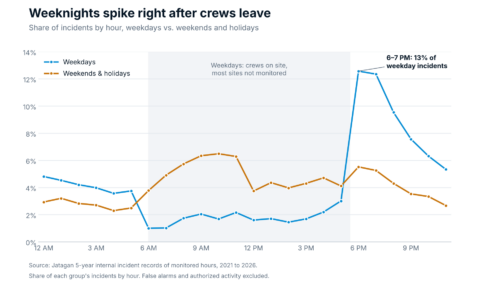
[Weeknight incidents spike in the first hours after crews leave.]
Weekend mornings are a blind spot
On weekends, the busiest four hours were 8 AM to 12 PM, with 25% of weekend and holiday incidents. That surprises most people. Daylight feels safe.
But on a Saturday morning, a jobsite looks like any other empty lot. There’s no crew to question a pickup truck at the gate. Someone loading copper wire or tools in daylight looks like a worker, not a thief.
Weekend timing changes with the season
On weekends and holidays, the season decides when risk peaks. Mid-morning leads for most of the year. Summer is the one exception.
- Winter, spring and autumn: 8 AM to 12 PM is the busiest weekend window. In winter, more than half of weekend incidents happen in daylight.
- Summer: activity moves to 6 to 10 PM, when long, light evenings keep people out.
- Autumn is the transition. Mornings still lead, but evenings run nearly even.
Weeknights don’t follow the seasons. The 6 to 10 PM window is the busiest on weeknights all year; it simply gets more concentrated from spring through autumn. Summer months also ran about 15% busier overall than winter.
Full 24-hour weekend monitoring covers every one of these patterns. Nights-only weekend coverage misses the morning peak for most of the year.
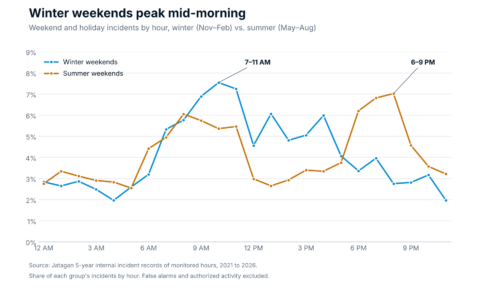
[Weekend risk shifts from mornings in winter to evenings in summer.]
Late night still matters
Most people assume construction theft peaks after midnight. In our records, 11 PM to 3 AM was not the peak, but it was far from quiet. It held about a fifth of weeknight incidents in every season. The overnight hours need coverage too; they just aren’t the whole story.
Peak theft windows at a glance
When | Busiest 4-hour window | Share of incidents in that window |
|---|---|---|
| All days combined | 6–10 PM | 32% |
| Weeknights, all year | 6–10 PM | 42% |
| Weeknights, by season | 6–10 PM | 33% (winter) to 48% (summer) |
| Weekends and holidays, all year | 8 AM–12 PM | 25% |
| Weekends, winter (Nov–Feb) | 8 AM–12 PM | 27% |
| Weekends, spring (Mar–Apr) | 8 AM–12 PM | 27% |
| Weekends, summer (May–Aug) | 6–10 PM | 25% |
| Weekends, autumn (Sep–Oct) | 8 AM–12 PM | 22% |
Source: Jatagan internal incident records of monitored hours, 2021 to 2026, false alarms excluded.
What this means for your security schedule
The hours you protect matter as much as the equipment you install. Our general guide to reducing construction site theft and vandalism covers fencing, lighting and site layout. Timing is the piece most plans leave to chance.
- Make sure weeknight coverage starts early. The busiest weeknight window runs from 6 to 10 PM. A plan that only covers late night and early morning misses the heaviest stretch.
- Cover weekends around the clock. Weekend mornings are prime time, so nights-only coverage misses a large share of the risk.
- Plan for holiday shutdowns early. Treat a long weekend or a winter break as a sustained exposure, not a few extra nights.
- Expect busier summer evenings. In summer, nearly half of weeknight incidents fall between 6 and 10 PM, so the first hours after crews leave matter most.
- Make sure someone is watching, not just recording. An alert at 6:15 PM on a Saturday is only useful if a person sees it and acts. That’s the idea behind 24/7 live video monitoring with AI plus two trained human agents on every feed.
Our construction site security team can map a schedule to your crew hours and shutdown dates.
Frequently asked questions
When does construction site theft happen most?
In Jatagan’s 2021–2026 incident records, over 40% of incidents happened on weekends and holidays. On weeknights, the busiest window was 6 to 10 PM, right after crews leave. On weekends, it was 8 AM to 12 PM.
What day of the week is construction theft most likely?
Saturdays and Sundays carry the highest risk per day, because sites sit empty for roughly 60 hours. Holiday weekends extend that window and are among the riskiest periods of the year.
Does construction theft only happen at night?
No. On weekends, the busiest hours in our data were mid-morning. An empty site in daylight draws little attention, and a person loading materials can easily pass for a worker.
Is construction site theft worse in summer or winter?
Summer months were about 15% busier, but timing changed more than volume. On weekends, 8 AM to 12 PM was the busiest window in winter, spring and autumn, while summer shifted to 6 to 10 PM. Weeknights peaked from 6 to 10 PM in every season.
What hours should construction site security cover?
On weeknights, from early evening until crews return, plus full 24-hour coverage on weekends and holidays. Adjust the schedule by season so the busiest hours are never left unwatched.