


Table of Contents
- Introduction: The Question Every Construction Site Should Ask
- Why Construction Sites Are Never Static
- How Static Security Plans Create Real Losses
- The Cost of Blind Spots on Active Job Sites
- What Adaptive Construction Security Looks Like in Practice
- Comparing Static vs Adaptive Security Models
- How Jatagan Delivers Rapidly Adaptive Protection
- Key Takeaways for Construction Leaders
- Frequently Asked Questions
1. Introduction: The Question Every Construction Site Should Ask
The construction industry loses billions of dollars every year to theft and vandalism. From stolen copper and tools to heavy equipment and materials, these losses don’t just impact project budgets — they delay schedules, increase insurance costs, and create cascading operational risk. Despite significant investment in cameras and monitoring systems, construction sites remain some of the most targeted environments for property crime. The reason isn’t a lack of security presence. It’s a mismatch between how fast construction sites change and how slowly most security plans adapt.
If your construction site had physical changes recently, did your security plan change with it?
For most construction projects, the honest answer is no. Schedules move fast, site layouts evolve weekly, and priorities stay focused on progress, safety, and deadlines. Security, however, is often treated as something installed early and revisited only after a loss occurs.
This gap between how construction sites operate and how security is managed is one of the most common reasons theft, vandalism, and unauthorized access continue to plague active job sites. Risk does not stay still — and security cannot afford to either.
2. Why Construction Sites Are Never Static
Unlike permanent facilities, construction sites are in constant motion. Physical changes happen gradually, then suddenly, and often without a formal review of how those changes affect protection.
Common site changes include:
- New structures erected that obstruct existing camera views
- Conex boxes and temporary storage units being relocated
- Lighting conditions shifting as work progresses or seasons change
- Fencing moved to accommodate new phases of work
- Materials and high-value equipment relocated frequently
- Access points opening and closing as crews rotate
Each of these changes subtly alters risk. Over time, those small shifts compound into major blind spots that security systems were never designed to handle.

3. How Static Security Plans Create Real Losses
Most construction security plans are built around a snapshot of the site at a specific moment in time. Cameras are placed, rules are configured, and coverage assumptions are made based on that initial layout.
As the site changes, those assumptions quietly become invalid.
Static security plans typically suffer from:
- Fixed camera and unit locations that no longer cover critical areas
- Impaired sight lines caused by new structures or stacked materials
- Blocked views that go unnoticed until after an incident
- Growing blind spots that invite opportunistic theft
This is where losses happen — not because security is absent, but because it has not kept pace with reality.
4. The Cost of Blind Spots on Active Job Sites
Blind spots on construction sites are more than technical issues; they translate directly into financial and operational impact.
Consequences include:
- Theft of copper, tools, and heavy equipment
- Project delays caused by missing materials
- Increased insurance claims and premiums
- Disputes over responsibility and response
- Erosion of trust between owners, contractors, and security providers
In many cases, investigations reveal that warning signs existed. Cameras were partially blocked. Alerts were triggered but lacked context. Response was assumed but never verified.
Static security does not fail loudly. It fails quietly — until the loss is undeniable.
5. What Adaptive Construction Security Looks Like in Practice
Adaptive construction security acknowledges one core truth: job sites change faster than traditional security models can handle.
An adaptive approach focuses on continuous validation rather than one-time installation. It includes:
- Regular review of camera views as structures rise and layouts shift
- Adjustment of analytics rules as site activity evolves
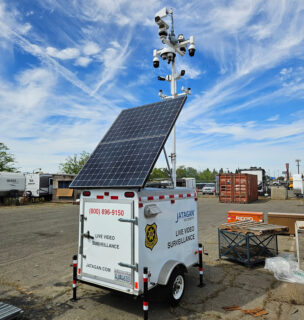
- Relocation or reorientation of security units as risk moves
- Ongoing identification and closure of emerging blind spots
- Verification that alerts lead to real, documented response
Protection should evolve with the site — and improve over time.
There is no set-and-forget in construction security.
6. Static vs Adaptive Security Models
| Aspect | Static Security | Adaptive Security |
|---|---|---|
| Site Changes | Ignored until incident | Continuously assessed |
| Camera Coverage | Fixed | Adjusted as site evolves |
| Blind Spots | Discovered after loss | Identified proactively |
| Alert Handling | Automated, assumption-based | Interpreted and reviewed by human |
| Outcomes | Reactive | Preventive and improving |
This comparison highlights why static models struggle in dynamic environments like construction sites.
7. How Jatagan Delivers Rapidly Adaptive Protection
Jatagan Security is built around the understanding that protection must move as fast as the environment it defends.
Our approach combines:
- Advanced analytics to detect risk signals
- Human review to apply judgment and context
- Continuous validation of camera views and coverage
- Verified response rather than assumed action
By closing the gap between detection and decision-making, Jatagan ensures that security strengthens as the project progresses — not just at the beginning.
This is how we deliver:
- Rapidly Adaptive security models
- Proven Protection grounded in real outcomes
- Verified Results clients can trust
8. Key Takeaways for Construction Leaders
- Construction sites are dynamic; security must be as well
- Static security plans create blind spots over time
- Most losses occur where protection failed to adapt
- Continuous validation is more effective than periodic reviews
- Security success is measured by outcomes, not installations
9. Frequently Asked Questions
Why can’t construction security be set up once and left alone?
Because site layouts, access points, and risk profiles change constantly. What worked last month may be ineffective today.
How often should security be reviewed on a construction site?
Security should be reviewed whenever meaningful physical changes occur and on a regular cadence throughout the project lifecycle.
Is more technology the answer to construction theft?
Not necessarily. Technology without adaptation and oversight often creates false confidence. The key is continuous adjustment and validation.
What makes Jatagan different from traditional security providers?
Jatagan focuses on adaptive protection, combining analytics with human judgment and verified response to ensure security improves over time.
How can construction teams reduce repeat losses?
By identifying why previous incidents occurred, closing the underlying gaps, and ensuring those corrections persist as the site evolves.