


They Had Cameras. They Still Got Hit.
Two avoidable failures behind break-ins at sites that already had full camera coverage and video monitoring.
Sites that get broken into have already had cameras. Many have a monitoring contract as well. The cameras recorded, the system was live, and the owner still found out the next morning that the site was vandalized or broken into by theft. When we are asked to look at these systems afterwards, the same two failure points come up again and again.
Table of contents
1. The pattern: full coverage, still hit
2. Failure 1: Camera deployment
3. Failure 2: Monitoring
4. The two failures at a glance
5. Four questions to ask any video security provider
6. Why this matters for outdoor sites in Sacramento and the Bay Area
7. Frequently asked questions
The pattern: full coverage, still hit
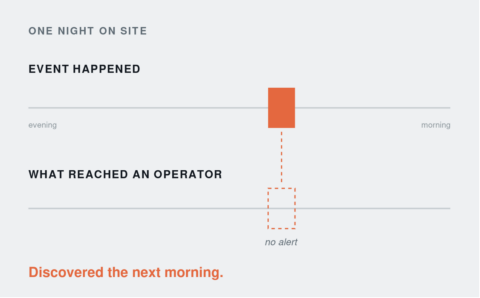
On paper these sites were well covered: IP cameras across the property, video recording, and a monitoring contract in place. What that doesn’t tell you is what happened on the night itself: an event took place, the system missed the threat, and no operator was ever notified. Which link broke varies — cameras not covering the critical areas, an image too coarse at that distance in the dark, an operator watching too many screens, or analytics that never raised an alert. The outcome is identical, the system fails.
Failure 1: Camera deployment
Poor camera placement and targeting
Placement starts with a question that often goes unasked: which areas on this site actually matter? Entry and exit points, gates and fence lines, the yard where the high-value equipment sits. Each of those critical areas needs a camera positioned and aimed to cover it — not a camera nearby that happens to catch part of it in frame. In practice, many cameras go up where mounting is easy: near power, near the network drop, or the corner that already has a bracket.
Sight lines also drift over time. On a working site, a connex box gets dropped in front of a camera, material is stacked where it wasn’t last month, a trailer parks across the view. A camera that covered the yard the day it was commissioned can be looking at the side of a container by the time it matters — and nothing reveals it. A camera aimed at a wall of steel looks exactly like a camera doing its job.
Wrong equipment settings and capabilities
Many providers take a camera’s specifications at face value. The data sheet gives a detection range, a field of view, an infrared distance, and that becomes the plan — without anyone confirming what the camera actually resolves on this site, at this distance, in this light. Published figures come from controlled conditions, and a yard at 2 a.m. is not those conditions: infrared reaches a fraction of its specified distance once it has to light a real scene, and exposure settings tuned in daylight behave differently after dark. Testing the cameras on site at night settles the question, and it is the step most often skipped — even though night is when the system is actually being asked to work.
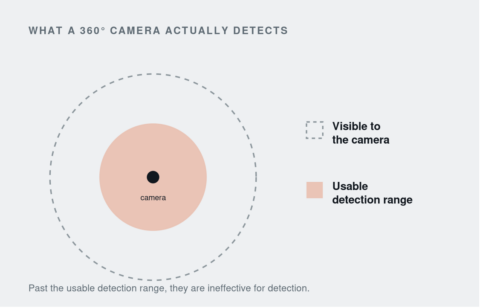
360° cameras are the clearest example. They appear to see in every direction, which makes them an easy sell to clients. In practice, they are short-range devices. Under the DORI framework in IEC 62676-4, identifying a person needs roughly ten times the pixel density required to detect that something moved — and at night it is worse. Past the small usable detection area, they are literally ineffective for the purpose of detection.
Failure 2: Monitoring
Poorly trained, overloaded operators
More often than not, monitoring is not performed by the company whose name is on the contract. Many providers subcontract it to low-cost offshore centers, which keeps the price down and puts training, supervision and accountability outside the provider’s control. The buyer has no visibility into who is actually watching their site, what those operators have been trained on, or how many other properties they are covering at the same time.
These days, most operators are working through AI alerts rather than watching feeds, and outdoor sites generate a great many false alarms — headlights, weather, animals, moving vegetation. A single operator may be responsible for hundreds of cameras across dozens of sites. Working a queue like that, the pressure is to clear alerts quickly, and a real event arriving among the nuisance ones can be dismissed in the same motion as the rest.
AI-triggered monitoring model
The deeper problem is architectural. With AI-monitoring, the human sits downstream of the analytics: software watches the feed, classifies a person or vehicle, raises an alert, and only then does an operator look. If the alert never fires, nobody looks — and outdoors, alerts fail more often than buyers expect: rain, fog, headlights, moving vegetation, poor night contrast, obstructions. There is no error message for an intrusion the analytics never classified, so a missed detection looks exactly like a quiet night.
The two failures at a glance
| Failure point | What it looks like on site | What it costs you | Ask your provider |
|---|---|---|---|
| Camera placement and targeting | Cameras on convenient mounts near power and network; critical areas uncovered or blocked | Critical areas not covered | Which areas are covered and which aren’t? |
| Equipment settings and capability | Wrong camera lens or type; 360° cameras asked to cover long range; settings never tested after dark | Failure to detect anything beyond the usable detection area | What’s the usuable detection range at night? |
| Operator load and training | Monitoring subcontracted offshore; one operator covering hundreds of cameras across many sites | The event is on screen and nobody sees it | Who’s watching when the operator is overloaded? |
| AI-triggered monitoring model | Humans only respond once analytics raise an alert | A missed detection produces no alert and no record of the miss | What happens when AI doesn’t alert? |
Four questions to ask any video security provider
Worth asking about your existing system as much as a new one. Vague answers are the answer.
1. Which areas are covered — and which aren’t?
2. What’s the usable detection range at night?
3. What happens when AI doesn’t alert?
4. Who’s watching when the operator is overloaded?
A provider who knows your site can answer all four with specifics. If they can’t, keep looking.
Why this matters for outdoor sites in Sacramento and the Bay Area
Both failures bite hardest on large outdoor sites, and Northern California has plenty of them: construction across Sacramento and the Bay Area, equipment and material yards, distribution facilities along the freight corridors, auto lots, recycling operations. Acres of ground, high-value material sitting in the open, and twelve hours a night with nobody there. Active sites are harder still, because the layout changes week to week as material moves and structures go up. Add valley fog and unlit perimeters, and the disparity between what a system was specified to do and what it actually does at 3 a.m. gets even wider.
The takeaway
A quiet night is not evidence that your system worked. Cameras on site are not the same thing as crime prevention, and the gap between the two is measurable before anything goes wrong. If you can’t answer the four questions above about your own property, that gap is where to start.
Frequently asked questions
1. Do security cameras prevent theft?
Not on their own. Cameras record; they don’t intervene. Prevention requires an event to be detected while it is happening and someone to respond while the intruder is still on site. Without live monitoring behind it, a camera is just an evidence tool.
2. Why didn’t my security cameras stop the break-in?
Usually one of two reasons: the cameras weren’t covering the route the intruder used, or nobody was alerted while it was in progress. Footage from that night, read against the site’s coverage map, normally shows which applies.
3. How far can a 360-degree camera actually see?
A 360° camera spreads one sensor across a full circle, so the range at which it supports identification is far shorter than the range at which something appears in frame. 360° cameras are short-range devices that suit gates and close yards, not long perimeters.
4. Can AI video analytics miss an intruder?
Yes, and outdoors it happens more than most buyers expect. Rain, fog, headlights, moving vegetation, low night contrast, and obstructions all reduce reliability. The critical part is that a miss is silent — no alert is generated, so there is no record anything was missed.
5. What’s the difference between recorded video and live video monitoring?
Recording captures what happened, for review afterwards. Live video monitoring means trained people are watching in real time and can act while an event is in progress — audio warning, verification, law enforcement. The difference is what happens in the minutes that count.