


360° security cameras for outdoor sites can be useful—but only when they are assigned the right job.
A panoramic camera can provide a broad overview from one mounting point. That is valuable when monitoring agents need to understand movement across a compact yard, loading area, warehouse, or construction zone. The problem begins when a wide field of view is treated as proof that every part of a large outdoor property is adequately protected.
Different areas have different security requirements. A long fence line may need early detection. A vehicle gate may require focused detail. Stored equipment may need a close, unobstructed view. A central yard may benefit from broad situational awareness.
One camera type rarely performs all of those jobs equally well.
Bottom line: 360° cameras work best as overview cameras for compact, relatively open areas. They are less effective as the sole protection for long fence lines, distant approaches, gates, or high-value assets. Large outdoor sites generally require a combination of overview, directional, and long-range cameras.
Table of Contents
- What Does 360° Camera Coverage Actually Mean?
- Where 360° Security Cameras Work Well
- Where 360° Cameras Fail—and the Placement Mistakes That Cause It
- Match the Camera to the Site Zone
- What an Effective Outdoor Camera Plan Should Include
- Why Monitoring and Response Still Matter
- How Jatagan Designs Outdoor Camera Coverage
- Conclusion
- Frequently Asked Questions
1. What Does 360° Camera Coverage Actually Mean?
“360° camera” can describe several technologies.
A fisheye camera uses one wide-angle lens to capture a circular view. A multi-sensor panoramic camera combines several lenses in one housing. A pan-tilt-zoom camera can rotate through 360°, but it normally points and zooms toward one selected area at a time.
These designs are not interchangeable. More importantly, the 360° specification describes a field of view—not the camera’s complete security performance.
It does not tell you:
- How far away a person can be reliably detected
- How much detail remains at the perimeter
- How the camera performs in complete darkness
- How obstructions affect the view
- Whether analytics will classify the activity correctly
- Whether anyone will intervene in time
Axis Communications describes single-sensor 360° panoramic cameras as well suited to overview surveillance, while noting that the pixel density required for recognition or identification is generally achieved relatively close to the camera.
A person may therefore appear somewhere in a wide image without being shown at the distance, angle, or level of detail needed for early detection and effective intervention.
The right question is not simply:
“Can this camera see the area?”
It is:
“What security task can this camera perform reliably in this area?”
For a more technical explanation of field of view, image detail, and nighttime detection, see our separate guide to 360° vs. 180° vs. 90° security camera detection range.
2. Where 360° Security Cameras Work Well
A sound outdoor security plan should not reject 360° cameras. It should use them where their strengths match the objective.
Compact, Open Areas
A 360° camera can work well near the center of a relatively small, unobstructed courtyard, loading apron, equipment area, or warehouse section.
When activity remains reasonably close, the broad view can help operators follow movement without constantly switching between several camera feeds.
Indoor and Covered Environments
Warehouses, lobbies, and covered loading areas generally have shorter viewing distances, more stable lighting, and fewer large obstructions than exposed outdoor perimeters.
A panoramic camera can be effective when used for broad awareness within a defined area—not long-range detection across a large property. Panoramic-camera guidance similarly positions single-sensor models primarily as overview-surveillance tools.
Situational Awareness
An overview camera can help an operator understand:
- Where a person entered
- Which direction the person is moving
- Whether other people or vehicles are involved
- How the activity relates to gates, buildings, vehicles, or stored materials
That context is especially useful when separate focused cameras cover the perimeter and highest-risk targets.
Incident Review and Site Documentation
A broad recorded view can help reconstruct movement before and after an event. It may also support safety review, construction documentation, or general site oversight.
These are valid uses. They are simply different from identifying suspicious activity at the far edge of a property early enough to stop a loss.
A Supporting Role in a Mixed-Camera Design
One of the strongest applications for a 360° camera is as a supplemental overview.
Directional or long-range cameras can protect fence lines, entrances, and critical assets, while the panoramic camera provides broader context.
The problem is not using a 360° camera. It is expecting one panoramic camera to perform every security function by itself.
3. Where 360° Cameras Fail—and the Placement Mistakes That Cause It
Long Fence Lines and Distant Approaches
A large outdoor property may have hundreds or thousands of feet of exposed perimeter. A centrally mounted panoramic camera may display the overall site while placing the fence line at the greatest distance from the lens.
That can delay detection until a person is already well inside the property.
Perimeter cameras often need to be aimed along likely approaches, fence lines, gates, and access points. Early detection depends on camera direction and useful image detail—not merely whether the boundary appears somewhere in the frame.
High-Value Targets Requiring Focused Detail
Copper, tools, generators, fuel tanks, vehicles, equipment, storage containers, and building entrances frequently require a focused view.
An operator may need to determine whether someone is:
- Cutting a lock
- Entering a piece of equipment
- Removing materials
- Tampering with a fuel tank
- Loading property into a vehicle
A broad overview may show that activity is occurring without providing the best angle or detail for a fast response.
Central or Excessively High Mounting
Placing a 360° camera in the center of a property can create an impressive overview while making the perimeter—the first place an intruder should be detected—the most distant part of the scene.
Greater height can reduce nearby obstructions, but excessive height may make people and actions appear smaller. It can also create steep viewing angles around vehicles, containers, walls, and covered areas.
Placement should be based on the security objective, not automatically on the center or highest available point.
Obstructions and Changing Site Conditions
A 360° field of view does not see through:
- Containers
- Temporary buildings
- Stacked materials
- Privacy mesh
- Parked vehicles
- Heavy equipment
- Scaffolding
- New walls or structures
This is particularly important on construction sites. A position that works during site preparation may become ineffective after buildings rise, equipment moves, fencing changes, or valuable materials are relocated.
A camera can retain a 360° field of view while much of that view becomes blocked, irrelevant, or directed away from the current risk.
Field-of-View Maps Mistaken for Detection Maps
Security proposals often use colored circles or cones to show where cameras can theoretically see. These drawings can be useful, but they should not be mistaken for verified detection zones.
Ask what each area on the plan is expected to accomplish:
- General visibility
- Human detection
- Behavioral assessment
- Recognition or identification
- Vehicle or license-plate capture
A camera view without a stated security objective can create false confidence.
Daytime Placement Tested for a Nighttime Problem
Outdoor sites can include complete darkness, uneven lighting, headlights, glare, reflective fencing, dust, fog, rain, and deep shadows.
Camera positions should be evaluated under the conditions in which the property is most vulnerable—not only during a daytime walkthrough.
For an examination of one commonly advertised wide-angle coverage claim, see Can Four Security Cameras Really Cover 360° at 150 Feet?
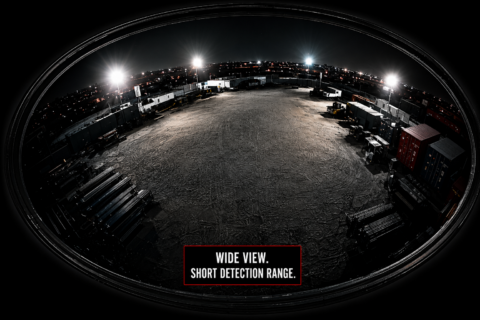
[Broad Overview. Limited Perimeter Detail.]
4. Match the Camera to the Site Zone
A strong deployment often uses different camera types for different jobs.
| Site zone | Primary objective | Camera approach commonly suited to the task |
|---|---|---|
| Compact courtyard or loading area | Broad situational awareness | 360° or panoramic overview camera |
| Vehicle gate or driveway | Observe behavior and capture vehicle detail | Focused directional camera; license-plate camera when needed |
| Long fence line | Detect a person early along the perimeter | Long-range directional or specialty perimeter camera |
| Equipment or material storage | Closely observe activity around valuable assets | Focused cameras with complementary views |
| Building corner | Cover two defined sides | Two directional cameras or a suitable multi-sensor camera |
| Large central yard | Understand overall movement | Overview camera supported by focused perimeter cameras |
| Difficult low-visibility area | Maintain detection under specific conditions | Thermal or hybrid camera when justified |
| Changing construction zone | Keep coverage aligned with evolving risks | Repositionable cameras or surveillance units with periodic reviews |
The design should begin by defining:
- What must be detected in each zone
- At what distance it must be detected
- Under what lighting and environmental conditions
- How much time is needed to intervene
A 360° camera may be right for one area and wrong for another area on the same property.
5. What an Effective Outdoor Camera Plan Should Include
Perimeter Routes and High-Value Targets
Identify fence lines, gates, roads, adjoining properties, pedestrian approaches, vehicle routes, and areas where someone can enter without being easily observed.
Also mark likely targets such as:
- Copper and electrical materials
- Tools
- Generators
- Fuel
- Vehicles
- Heavy equipment
- Storage containers
- Building entrances
The largest area is not always the highest-risk area.
A Defined Purpose for Every Camera
Each camera should have a stated job:
- General overview
- Early perimeter detection
- Close observation of a target
- Vehicle or license-plate capture
- Confirmation of suspicious behavior
- Tracking or incident review
When one camera is expected to perform all of these functions, some are likely to be compromised.
Nighttime Conditions and Obstructions
Evaluate ambient light, total-darkness areas, headlights, reflective fencing, glare, and objects that may block the view.
Account for both current and expected conditions. On an active construction site, future structures and changing material storage may be as important as what is present on installation day.
Time Available for Intervention
Identify where suspicious activity should first be detected and how much distance remains before the person reaches the target.
Earlier detection creates more time for:
- Live voice-down warnings
- Flashing lights or sirens
- Guard response
- Client notification
- Police escalation
A camera that first provides actionable information after someone reaches the protected asset leaves little time to prevent a loss.
Testing and Ongoing Adjustment
After installation, validate:
- Actual camera views
- Nighttime performance
- Analytics
- Audio and visual deterrence
- Monitoring procedures
- Escalation protocols
Review coverage whenever the property changes materially. Security deployment should evolve with the site rather than remain fixed to the original installation plan.
6. Why Monitoring and Response Still Matter
Correct camera placement is essential, but cameras are only the sensing layer.
An effective operation must also determine who reviews activity, how quickly it is interpreted, what deterrence is available, when the client or authorities are contacted, and whether the event is monitored until it is resolved.
Jatagan’s AI-Augmented DHDMSM (Dual-Human Detect & Monitor) combines continuous AI analysis with two trained monitoring agents who actively observe live video rather than waiting only for AI-generated alerts.
Strong monitoring cannot fully compensate for poor camera placement. Strong camera placement cannot prevent crime without a dependable intervention process.
Camera deployment, monitoring, deterrence, and response must work as one system.
7. How Jatagan Designs Outdoor Camera Coverage
Jatagan begins with the site rather than a predetermined camera type, camera count, or surveillance-tower formula.
The design considers:
- Site geometry and linear footage
- Perimeter exposure
- Likely intrusion routes
- Location of valuable assets
- Nighttime lighting and environmental conditions
- Current and expected obstructions
- Power and connectivity
- The appropriate combination of surveillance units and cameras
A compact central area may benefit from an overview camera. A gate may require focused vehicle coverage. A long fence line may require cameras aligned along the perimeter rather than a broad view from the center.
For large outdoor perimeters, Jatagan’s Range-Boosted AI Camera SystemTM is designed to provide up to approximately 1,600 feet of perimeter coverage with two cameras in suitable configurations, including complete-darkness applications.
A 3,000-Foot Construction Perimeter
At a Costco distribution center under construction in Tracy, California, the site’s longest side was a 3,000-foot fence line—more than half a mile.
A conventional approach was estimated to require six to ten surveillance towers and more than 20 cameras for that length. Jatagan addressed the perimeter using one Solar Mobile GuardTM with four Range-Boosted AI CamerasTM.
The lesson is not that every 3,000-foot perimeter requires the same configuration.
It is that camera direction, range, placement, lighting, site geometry, and response time should determine the deployment—not a generic camera-count formula.
Conclusion
A 360° security camera can be the right tool for broad awareness, compact open areas, indoor or covered spaces, incident review, and operator context.
It becomes the wrong tool when wide visual coverage is treated as proof of reliable perimeter protection.
A stronger design uses:
- Overview cameras for context
- Focused cameras for gates and valuable assets
- Long-range cameras for perimeter approaches
- Specialty cameras for difficult environmental conditions
- Active monitoring and response for intervention
The most important question is not:
“How many degrees can this camera see?”
It is:
“What must this camera detect, at what distance, under what conditions, and what happens next?”
That question produces a security design.
The first one produces only a coverage claim.
Protecting a construction site, industrial facility, outdoor storage yard, utility property, dealership, logistics center, or another large outdoor perimeter? Jatagan can evaluate the site plan or linear footage and design coverage around the property’s actual risks.
[Related Video: Why Camera Design and Monitoring Both Matter]
Frequently Asked Questions
Are 360° Security Cameras Good for Outdoor Use?
Yes, when used for the right purpose. They can provide useful situational awareness in compact, open, or short-range areas. They are not automatically the best primary camera for long perimeters, distant approaches, vehicle gates, or locations requiring focused detail.
Can One 360° Camera Secure an Entire Construction Site?
Usually not by itself. A construction site may require separate coverage for fence lines, gates, equipment, material storage, buildings, and changing work zones.
A 360° camera can provide an overview, but focused or long-range cameras are often needed for critical areas.
Do 360° Cameras Eliminate Blind Spots?
They can reduce directional gaps around the mounting point, but they do not eliminate site-level blind spots.
Buildings, containers, vehicles, fencing, equipment, distance, mounting height, and lighting can still create areas where activity is blocked or lacks useful detail.
What Is the Difference Between a 360° Camera and a PTZ Camera?
A fixed 360° camera records a broad surrounding view continuously.
A PTZ camera can pan, tilt, and zoom toward a selected area, but it generally provides its detailed view in one direction at a time. The two camera types serve different purposes and may be used together.
Do I Still Need Directional Cameras If I Have a 360° Camera?
Often, yes.
Directional cameras can provide focused views of gates, fence lines, high-value assets, and likely intrusion routes. A mixed-camera design combines panoramic context with the distance and detail required in critical zones.
How Often Should Camera Placement Be Reviewed on a Construction Site?
Review placement whenever the layout changes materially—for example, when walls rise, fencing moves, equipment relocates, materials are stored in new areas, or access routes change.
Periodic nighttime checks are also important because daytime views do not always reveal after-hours limitations.