


Three Layers of Protection. Comparable Pricing. Unmatched Results.
Key Takeaways
- AI and human operators both prevent crime, but neither is perfect on its own—unpredictable outdoor conditions and human fatigue mean any single detection layer will occasionally miss.
- Jatagan’s AI-Augmented DHDM℠ runs three independent layers simultaneously: AI plus two trained human monitoring agents, eliminating the single point of failure.
- The math of redundancy: three independent layers that each catch 80% of threats combine to catch 99.2% (an illustrative example, not Jatagan’s performance measurement).
- Clients get redundant monitoring at pricing comparable to single-layer services, with a Crime Prevention Success Rate above 99.9%, published and updated monthly.
Table of Contents
- What Is the Reliability Gap in Video Security?
- Why One Detection Layer Is Never Enough
- How Jatagan’s Three Layers of Protection Work
- What Security Can Learn from Aviation and Data Centers
- Does Redundant Monitoring Cost More?
- Measuring Reliability by Results, Not Specifications
- Three Layers vs. One Layer
- The Question to Ask Every Security Provider
- Frequently Asked Questions
Most outdoor video security providers compete on AI features. Some promote higher-resolution cameras; others advertise faster analytics. At Jatagan, we deliver something different: superior reliability at pricing comparable to conventional monitoring services.
Here’s why. AI prevents crime. Trained human operators prevent crime. But each is a single layer, and no single layer is perfect—AI can miss an event, and even the best operator can overlook one. A system is only as reliable as what happens when one layer misses.
So the real question to ask any security provider isn’t “How good is your AI?” It’s this: when your primary detection layer misses an intrusion, what catches it?
1. What Is the Reliability Gap in Video Security?
The reliability gap is the difference between a security system that usually works and one engineered to keep working even when a component fails. Most video monitoring services rely on a single detection path—typically AI analytics that alert a human operator. If the AI misses the event, the operator never sees it. That single point of failure is the reliability gap, and it’s where preventable crimes slip through.
The world’s most critical industries solved this problem decades ago. They stopped chasing perfect components and started engineering redundant systems. Jatagan applies the same principle to outdoor video security.
2. Why One Detection Layer Is Never Enough
No detection technology is perfect, because outdoor environments are unpredictable. Weather, shadows, headlights, vegetation, animals, and routine site activity all degrade AI detection accuracy. Human monitoring has limits too: even experienced operators can overlook an event during long sessions watching dozens of feeds.
Neither AI nor people are the problem. The problem is relying on only one of them. A system that depends on a single detection layer creates a single point of failure—and when that layer misses an intrusion, nothing is left to catch it.
Rather than trying to build a perfect detector, Jatagan built a more reliable system.
3. How Jatagan’s Three Layers of Protection Work
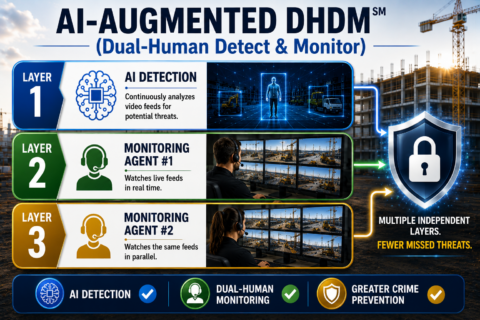
Jatagan’s AI-Augmented DHDMSM (Dual-Human Detect & Monitor) combines three independent detection layers watching the same live video feeds at the same time:
- Artificial intelligence analyzing every camera feed continuously
- Monitoring Agent #1, a trained professional actively watching live video
- Monitoring Agent #2, a second professional monitoring independently
This is not AI alerting one operator, and it is not one operator backing up another after the fact. All three layers detect and monitor simultaneously, giving every event multiple independent chances to be caught before a crime occurs. Because no single layer is solely responsible for detection, the architecture eliminates the single point of failure built into conventional monitoring.
The layers also fail differently, which matters. AI struggles with visual ambiguity but never gets tired. Humans excel at context and judgment but can lapse in attention. Combining detection methods with different failure modes is what makes redundancy work—not just having more of the same thing.
4. What Security Can Learn from Aviation and Data Centers
Reliability engineering isn’t unique to security. Commercial aircraft are certified under the FAA’s fail-safe design concept, which requires designers to assume the failure of any single component—regardless of how improbable—and prove the aircraft can still fly and land safely. Data centers duplicate servers, power supplies, and network paths—the Uptime Institute’s Tier standard, the international benchmark for data center reliability, rates facilities precisely by how well they tolerate the failure of any single component. Hospitals install backup life support. Nuclear facilities follow a principle the U.S. Nuclear Regulatory Commission calls defense in depth: multiple independent and redundant layers of defense, so that no single layer—no matter how robust—is exclusively relied upon. These industries share a simple understanding: perfect components don’t exist, but reliable systems do.
The math explains why. Imagine a simplified example where a single detection layer catches 80% of potential threats—meaning it misses 1 in 5. Add a second independent layer with the same accuracy, and the odds of both missing the same event drop to 4% (0.2 × 0.2). Add a third, and the combined miss rate falls to just 0.8% (0.2 × 0.2 × 0.2). Three imperfect layers, each catching 80%, produce a system that catches 99.2%.
This example illustrates the engineering value of redundancy; it is not Jatagan’s published performance measurement.
5. Does Redundant Monitoring Cost More?
No—Jatagan’s three-layer monitoring is priced comparably to single-layer services. Three layers of protection might sound like three times the cost, but Jatagan’s patented Redundant Live Monitoring SystemTM was designed specifically to let AI and two monitoring agents work together efficiently. Instead of tripling operating expenses, the architecture maximizes the effectiveness of each monitoring professional.
The result: clients get the reliability of redundant monitoring at pricing comparable to what they’d pay for a single-layer service. Better protection shouldn’t cost more—and with Jatagan, it doesn’t have to.
6. Measuring Reliability by Results, Not Specifications
The goal of outdoor video security isn’t to purchase cameras or monitoring hours—it’s to prevent crime. That’s why Jatagan measures success by outcomes. Our published Crime Prevention Success Rate has consistently exceeded 99.9%, calculated on a rolling 12-month dataset across active monitored deployments.
Unlike most providers, we publicly document our methodology and update our published performance monthly. Reliable systems should produce measurable, verifiable results.
7. Three Layers vs. One Layer
| Traditional Video Security | Jatagan Reliability Architecture |
|---|---|
| One primary detection method | AI + two trained monitoring agents |
| Single point of failure | No single point of failure |
| A missed detection becomes a missed intrusion | Multiple independent chances to catch every threat |
| One layer’s price | Three layers at comparable pricing |
| Performance rarely published | Success rate published monthly with documented methodology |
8. The Question to Ask Every Security Provider
Technology will keep evolving and AI will keep improving, but the engineering principle behind reliable systems won’t change. When failure isn’t an option, critical industries don’t bet on a single component—they build redundancy.
So instead of asking whether a provider’s AI is good enough, ask the question that reveals the reliability gap: when your primary detection layer misses an intrusion, what catches it?
For Jatagan, the answer is simple. Three Layers of Protection. Comparable Pricing. Unmatched Results.
9. Frequently Asked Questions
What is Jatagan’s DHDM monitoring system?
AI-Augmented DHDMSM (Dual-Human Detect & Monitor) is Jatagan’s approach to live video monitoring in which artificial intelligence and two human monitoring agents independently watch the same camera feeds simultaneously—built on Jatagan’s patented Redundant Monitoring System—eliminating the single point of failure found in conventional monitoring.
Why isn’t AI video surveillance enough on its own?
Outdoor conditions—weather, lighting, vegetation, animals, site activity—cause even advanced AI to miss events. Without an independent backup layer, every AI miss can become a missed intrusion.
Does three-layer monitoring cost three times as much?
No. Jatagan’s patented Redundant Live Monitoring SystemTM lets AI and two monitoring agents work together efficiently, keeping pricing comparable to single-layer monitoring services.
How does Jatagan measure crime prevention performance?
Jatagan publishes a Crime Prevention Success Rate—consistently above 99.9%—calculated on a rolling 12-month dataset and updated monthly, using a publicly documented methodology.
What industries benefit most from redundant video monitoring?
Any site with valuable outdoor assets: construction sites, auto dealerships, equipment yards, logistics facilities, utilities, and commercial properties where a single missed intrusion carries a high cost.