


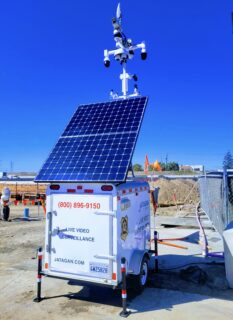
Mobile surveillance trailers are widely used at construction sites, industrial properties, equipment yards, vacant properties and other locations where permanent security infrastructure may not be practical. These properties can face after-hours risks ranging from theft of equipment and materials to trespassing, vandalism and unauthorized access. At first glance, many systems look similar. A trailer, a mast, several cameras, solar panels and some type of monitoring service.
The differences become clearer once you look past the hardware.
A system with more cameras is not automatically better. A lower monthly price is not necessarily less expensive overall. A camera that can see a distant fence line may not be able to detect a person there reliably at night. And the word “monitored” can describe very different operating models.
For buyers comparing providers, the most useful questions are about actual coverage, detection, intervention, reliability and total service requirements.
Table of Contents
- Start With the Site, Not the Trailer
- Compare Usable Camera Coverage
- Ask About Nighttime Detection Distance
- Understand How the Monitoring Actually Works
- Compare Deterrence and Intervention
- Evaluate Power Reliability
- Ask What Happens When Connectivity Fails
- Understand Field Service and Maintenance
- Compare Total Cost, Not Just Monthly Pricing
- Mobile Surveillance Trailer Comparison Table
- Questions to Ask Before Choosing a Provider
- Frequently Asked Questions
Start With the Site, Not the Trailer
One of the easiest mistakes is starting with equipment specifications before deciding what the site actually needs.
A five-acre rectangular property with an open perimeter may be easier to cover than a smaller site filled with buildings, containers, equipment and blind corners. Perimeter length, sight lines, entrances and the location of valuable assets can matter more than acreage alone.
Before comparing providers, identify:
- the areas that must be protected after hours;
- likely intrusion routes;
- high-value equipment or materials;
- sections of the perimeter that are difficult to observe;
- locations where parked vehicles or structures may obstruct cameras.
The right surveillance design should follow the risk. The trailer is simply one part of that design.
1. Compare Usable Camera Coverage
Camera count is one of the easiest specifications to compare, which is probably why it receives so much attention.
But it can also be misleading.
A trailer with six cameras does not necessarily provide better protection than one with four if those four cameras provide longer usable detection distances or are positioned more effectively. On large properties, use of long-range perimeter cameras coupled with efficient camera placement can reduce the number of surveillance units required.
Ask the provider to explain how much of your actual property one unit is expected to cover.
That answer should consider:
- perimeter length;
- camera type and lens;
- obstacles;
- elevation;
- required detection distance;
- nighttime conditions;
- the direction intruders are likely to approach.
Be cautious with broad statements such as “covers five acres” or “provides 360-degree coverage.” Those descriptions may be useful as general specifications, but they do not tell you whether a person can be reliably detected at the far edge of the property.
The more useful question is:
What can this system reliably protect on my site?
2. Ask About Nighttime Detection Distance
Security systems often perform very differently after dark.
A camera may produce a recognizable daytime image hundreds of feet away while providing much less useful detection at night. Wide-angle cameras can cover a large scene but may sacrifice detail and detection distance.
This distinction matters most on large outdoor properties.
Ask providers to separate three concepts:
Viewing range: how far something can be seen on the image.
Detection range: how far the system can reliably determine that a person or relevant object is present.
Identification range: how far enough detail is available to identify specific characteristics.
Those are not interchangeable.
For perimeter security, detection is usually the critical issue. The goal is to recognize suspicious activity while there is still time to intervene, not simply record someone once they are close to the trailer.
3. Understand How the Monitoring Actually Works
“Live monitored” and “24/7 monitored” can sound straightforward, but providers may use those terms differently.
Some systems rely primarily on AI analytics. When the software detects activity, an event is sent to a monitoring operator for review.
Other systems use different combinations of automated detection and active human monitoring.
Neither description should be accepted at face value. Ask what happens in practice.
Useful questions include:
- When does a human operator first see the event?
- Does human review depend on an AI alert?
- What happens if the software does not trigger?
- How many operators are responsible for the site?
- What hours are actually monitored?
- What happens after an intrusion is confirmed?
A buyer should understand the operating model before comparing monitoring services on price.
4. Compare Deterrence and Intervention
A surveillance trailer can serve two very different purposes.
One is to document activity.
The other is to help stop it.
If prevention is the objective, ask what the system can do once suspicious activity is detected.
Depending on the provider, intervention may include:
- live voice-down warnings;
- prerecorded audio;
- flashing lights;
- sirens;
- air horns;
- notification of designated personnel;
- law-enforcement escalation.
The effectiveness of deterrence also depends on timing. A warning delivered while someone is still approaching the site can be much more useful than one issued after the person has reached high-value equipment.
The key question is not simply whether a trailer has speakers or lights. It is whether there is a defined process for using them during an actual event.
5. Evaluate Power Reliability
Many mobile surveillance trailers rely heavily on solar power, which makes them practical for properties without electrical service.
Solar systems, however, should not be evaluated only by the size of the panels.
Ask what happens during:
- several days of poor weather;
- heavy shade;
- winter conditions;
- dirty or obstructed panels;
- unusually high system power consumption.
Battery capacity matters, as does the provider’s backup strategy.
Some systems may require temporary shutdowns or reduced functionality when power becomes limited. Others use backup generation, battery replacement or other methods to keep the system operating.
For security equipment, uptime matters more than the theoretical solar specification.
A useful question is:
What happens after several days when the solar panels cannot produce enough power?
6. Ask What Happens When Connectivity Fails
Most mobile surveillance systems depend on cellular or wireless connectivity to transmit video and communicate with a monitoring center.
That introduces another potential point of failure.
Ask:
- Which cellular networks are supported?
- Can the system use more than one carrier?
- What happens in areas with weak coverage?
- Does the provider know immediately if the connection drops?
- Is video recorded locally during an outage?
- Who restores service?
- How quickly is a communication failure addressed?
A camera system can remain physically powered and still lose much of its security value if the monitoring center cannot see it.
This is particularly important at rural construction sites, infrastructure projects and remote industrial properties where cellular coverage may be inconsistent.
7. Understand Field Service and Maintenance
Outdoor surveillance equipment operates in difficult conditions.
Dust accumulates on lenses and solar panels. Cameras can move. Batteries age. Equipment can be damaged by weather, vehicles or vandalism.
Ask what maintenance is included in the service.
A provider should be able to explain who handles:
- camera adjustment;
- lens cleaning;
- solar panel cleaning;
- battery problems;
- connectivity issues;
- damaged equipment;
- deterrence devices;
- relocation when site conditions change.
The answer matters because a system can appear operational while providing poor protection. A camera may still be online but pointed at the wrong area. A dirty lens may reduce nighttime image quality. A trailer may remain in place even though the risk has moved elsewhere.
Service quality is therefore part of security performance, not just a maintenance issue.
8. Compare Total Cost, Not Just Monthly Pricing
Monthly pricing is important, but it should not be compared in isolation.
Two providers can quote very different monthly rates while also proposing different numbers of trailers, cameras and service levels.
The total cost may include:
- monthly service;
- deployment charges;
- solar or power charges;
- distance or travel charges;
- monitoring;
- additional cameras;
- relocation;
- minimum contract terms;
- multiple units.
This is where coverage efficiency becomes especially important.
A lower-priced trailer is not necessarily the lower-cost solution if the property requires three of them instead of one.
Ask every provider to explain the complete design and total expected cost for protecting the same areas of the site.
That creates a much more meaningful comparison than looking at the monthly price of a single unit.
Mobile Surveillance Trailer Comparison Table
| What to compare | Why it matters | Question to ask |
|---|---|---|
| Usable coverage | Determines how much of the actual site is protected | How much perimeter can one unit reliably cover here? |
| Night detection | Daytime viewing distance may not reflect nighttime performance | At what distance can a person be reliably detected at night? |
| Monitoring model | “Monitored” can mean different things | When does a human operator become involved? |
| Deterrence | Recording alone may not stop an intrusion | What actions can be taken while the event is happening? |
| Power | Solar performance varies with conditions | What happens during extended low-sun periods? |
| Connectivity | Loss of communication can interrupt monitoring | What happens if cellular service fails? |
| Field service | Outdoor equipment requires ongoing attention | Who maintains and repairs the system? |
| Total cost | Unit price does not show full site cost | How many units and additional charges will my property require? |
Questions to Ask Before Choosing a Provider
Before making a decision, ask each company to answer the same questions about your property:
- How many units are you recommending, and why?
- How much of the perimeter will each unit cover?
- What is the usable nighttime detection distance?
- How does your monitoring service work?
- What happens when suspicious activity is confirmed?
- What happens if the AI misses an event?
- What happens if solar power becomes insufficient?
- What happens if connectivity drops?
- Who performs field maintenance?
- Which fees are included in the quoted monthly price?
- What is the minimum service term?
A provider should be able to explain these points in practical terms without relying entirely on equipment specifications.
The objective is not to find the trailer with the most cameras or the lowest advertised price. It is to find the system that provides the required coverage, stays operational and supports a clear response when something happens.
Jatagan designs mobile outdoor video security for sites throughout Northern California, including the Sacramento region and San Francisco Bay Area, around the specific needs of each property rather than applying a fixed number of trailers or cameras. Coverage, monitoring, power, connectivity and deterrence are considered together to match the site’s perimeter, layout and risk.
Frequently Asked Questions
1. How much does mobile surveillance trailer service cost?
Pricing varies by provider, equipment, monitoring level, number of cameras, deployment requirements and the number of units needed. Buyers should compare total site cost rather than only the monthly price of one trailer.
2. How much area can one mobile surveillance trailer cover?
There is no reliable answer based on acreage alone. Coverage depends on camera type, detection distance, obstacles, property shape, perimeter length and the locations that need protection.
3. Do mobile surveillance trailers work at night?
Yes, but nighttime performance varies significantly by camera and lighting conditions. Buyers should ask about usable nighttime detection distance rather than relying only on general viewing-range specifications.
4. Are mobile surveillance trailers monitored 24/7?
Some are, but monitoring models differ. Some systems depend on AI-generated events before a person reviews video, while others use different levels of live human monitoring. Ask the provider exactly how and when the site is monitored.
5. Are mobile surveillance trailers solar powered?
Many are designed primarily around solar and battery power. Buyers should ask about battery reserve, backup power and what happens during extended periods of poor solar production.
6. Can one surveillance trailer protect a large construction site?
Sometimes. The answer depends on the site’s perimeter, layout, camera capabilities and obstructions. Large properties may require multiple trailers, additional cameras or a different system design. The appropriate number should be based on a site assessment rather than a fixed camera- or trailer-per-acre formula.