


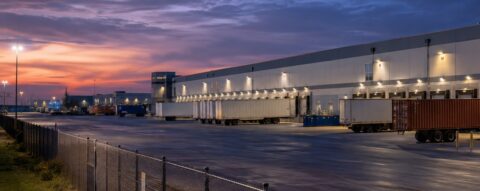
Warehouse security often focuses heavily on what happens inside the building: access control, cameras, alarms, inventory controls and procedures governing who can enter restricted areas.
But much of the risk at a 3PL or logistics facility exists outside the warehouse walls.
Trailer yards, loading docks, fence lines, employee parking areas and outdoor staging zones can cover several acres. They also change throughout the day as trucks arrive, trailers move and inventory is staged. At night, these same areas may have far fewer employees present to notice suspicious activity.
For third-party logistics (3PL) providers, warehouse operators and distribution centers, protecting the building is therefore only part of the security challenge. The outdoor property needs its own security strategy.
Table of Contents
- Why Outdoor Warehouse Security Deserves Special Attention
- Security Gap #1: Long Perimeters
- Security Gap #2: Trailer and Container Yards
- Security Gap #3: Loading Docks After Hours
- Security Gap #4: Changing Yard Conditions
- Security Gap #5: Remote Corners and Secondary Access Points
- Security Gap #6: Outdoor Staging Areas
- Security Gap #7: Detection Without Effective Intervention
- Designing Security for Large Logistics Properties
- What 3PL and Distribution Center Operators Should Evaluate
- Frequently Asked Questions
Why Outdoor Warehouse Security Deserves Special Attention
Outdoor areas present a different security problem from the inside of a warehouse.
Inside a building, walls, doors and controlled access points help define where people can go. Outside, the environment is much less controlled. A distribution center may have thousands of feet of fencing, multiple vehicle entrances, loading areas, parked trailers and large sections of property that are lightly occupied after hours.
Visibility is also constantly changing.
A camera may have a clear view across a yard one week and be partially blocked by parked trailers the next. An area used for empty pallets may suddenly become a temporary staging location for valuable inventory.
That makes outdoor security less about simply installing cameras and more about maintaining useful detection and coverage as the property changes.
| Outdoor area | Common security gap | What to evaluate |
|---|---|---|
| Fence line | Long stretches with weak or ineffective detection | Nighttime detection distance, camera placement and blind spots |
| Trailer yard | Trailers block sight lines and create hiding areas | Camera angles and changing trailer positions |
| Loading docks | Strong daytime activity but limited after-hours oversight | Coverage of approaches, dock doors and staging areas |
| Secondary entrances | Less employee activity and visibility | Detection, deterrence and escalation procedures |
| Outdoor staging | Inventory temporarily moved outside normal secured areas | Whether security coverage follows changing risk |
| Remote corners | Areas far from buildings and regular activity | Perimeter coverage and ability to intervene |
Gap #1. Long Perimeters That Are Not Effectively Monitored
A fence can discourage casual entry, but it does not tell you when someone climbs, cuts or bypasses it.
The challenge becomes greater as the property gets larger. A logistics facility may have a long perimeter with sections far from the main building, employee parking or vehicle gates.
One common mistake is assuming that because a camera can technically see a distant fence line, it can reliably detect suspicious activity there at night. Those are not necessarily the same thing.
Effective perimeter security depends on factors such as camera position, lighting, detection distance, obstructions and the size of the person or object being detected.
For large properties, the goal should not simply be to put more cameras around the fence. It should be to determine how much of the perimeter can be monitored effectively and where the true gaps remain.
Gap #2. Trailer and Container Yards
Trailer yards can be particularly difficult to secure because they are both valuable and visually complicated.
Rows of parked trailers create corridors and blocked views. A camera positioned correctly when the yard is half full may lose visibility when the same area reaches capacity.
Trailers may also contain valuable cargo, while empty trailers, containers and equipment provide concealment for someone moving through the property.
Security planning for these areas should account for more than the yard’s dimensions. Operators should consider how trailer positions change, which areas are occupied most often and where someone could approach without being easily observed.
Gap #3. Loading Docks After Hours
Loading docks are among the busiest areas of many logistics facilities during operating hours. Employees, drivers and equipment create constant activity.
That changes after hours.
Dock approaches may become quiet while still providing direct access to the building and nearby inventory. Recessed loading bays can also create areas that are difficult to see from cameras positioned primarily for daytime operations.
Operators should evaluate whether cameras cover not only the dock doors themselves, but also the routes someone would use to approach them.
The security question is different after midnight than it is at 2 p.m.
Gap #4. Changing Yard Conditions
One of the easiest security problems to overlook is change.
Logistics properties are dynamic environments. Trailers move. Containers arrive. Equipment is relocated. Temporary storage areas appear. Seasonal volume can dramatically change how a yard is used.
Those changes can affect camera coverage without anyone realizing it.
A camera may still be online and functioning perfectly while no longer providing the view it was originally intended to provide.
For that reason, outdoor security should be reviewed periodically rather than treated as a one-time installation. Incident activity can also provide useful information. Repeated attempts near the same section of perimeter, for example, may indicate that an area deserves additional attention.
Gap #5. Remote Corners and Secondary Access Points
Main entrances naturally receive attention. They usually have gates, lighting, employees and regular vehicle traffic.
Intruders have little reason to choose the most visible route.
Side fences, service entrances, rear property lines and areas behind buildings may present much easier opportunities, particularly at night.
These areas should be evaluated from an intruder’s perspective:
Where is activity lowest?
Where is visibility poorest?
Where would someone expect the slowest response?
A comprehensive outdoor security design should address these less obvious approaches rather than concentrating coverage around the main entrance.
Gap #6. Outdoor Staging and Temporary Inventory
Security risk can move with inventory.
Products, equipment or materials that normally remain inside the warehouse may temporarily be staged outdoors before loading or after unloading. At other facilities, pallets, containers, machinery or other assets may routinely remain outside.
These areas may not have been considered high-risk when the original security system was designed.
The question operators should ask is simple: Does security coverage follow the assets that need protection?
If valuable inventory moves into an outdoor area, the security plan may need to change with it.
Gap #7. Detection Without Effective Intervention
Seeing an intruder is only part of preventing a loss.
If suspicious activity is detected while it is occurring, the security operation needs a defined response. Depending on the situation, that might include a live voice warning, lights or sirens, contacting designated personnel or escalating to law enforcement.
The objective is intervention before the activity develops into theft, vandalism or a breach.
This is also why operators evaluating live video monitoring should understand exactly what happens after suspicious activity is detected. A recorded video may be useful as evidence later, but that is a different outcome from stopping the event while it is happening.
Designing Security for Large Logistics Properties
Large warehouses and distribution centers should not necessarily be secured simply by adding more conventional cameras or surveillance units.
System design matters.
Perimeter length, camera detection distance, building placement, yard layout, access points and obstructions all affect how much equipment is actually required.
For example, at a Costco distribution center in Northern California, Jatagan designed a system to protect approximately 3,000 feet of perimeter using one Mobile Guard surveillance unit and four Range-Boosted AI cameras. The site illustrates why coverage requirements cannot be determined by acreage alone.
A well-designed system can sometimes cover a large property more efficiently by placing equipment according to the actual risk and geometry of the site rather than applying a fixed number of cameras per acre.
What Should a 3PL or Distribution Center Evaluate?
When reviewing outdoor security, facility operators should look beyond whether cameras are installed and ask whether the system still provides useful protection.
Consider:
- Is the entire critical perimeter effectively monitored at night?
- Do parked trailers or containers create blind spots?
- Are loading docks adequately covered after operating hours?
- Are secondary entrances and remote fence lines monitored?
- Is temporary outdoor inventory included in the security plan?
- Can the system detect people at the distances required by the property?
- Is there a process for reviewing coverage as yard conditions change?
- What happens when suspicious activity is detected?
- Is responsibility clear if a camera, connection or monitoring process fails?
Facilities that already have IP cameras may not need to replace their entire system. In some cases, existing infrastructure can be supplemented with additional outdoor coverage or connected to a live monitoring service. The right approach depends on the existing equipment, property layout and level of risk.
Look Beyond the Warehouse Walls
Warehouse security does not stop at the building.
For 3PL providers and distribution centers, some of the most difficult areas to protect are outside: long fence lines, trailer yards, loading docks, temporary staging areas and remote portions of the property.
The most effective security plan starts by identifying where those exposures actually exist, then designing detection, monitoring and intervention around the way the property operates—not simply around the building itself.
Jatagan provides outdoor video security and live monitoring throughout Northern California, including the Sacramento region and San Francisco Bay Area, with solutions for warehouses, distribution centers and logistics facilities, including large-perimeter sites and facilities with existing IP camera systems.
Frequently Asked Questions
1. What are 3PL security solutions?
3PL security solutions are security measures designed for third-party logistics operations, including warehouses, distribution centers, loading areas, trailer yards and outdoor storage or staging areas. Depending on the facility, they may include video surveillance, perimeter monitoring, access control, live video monitoring and active deterrence.
2. What areas of a warehouse property are most vulnerable after hours?
Common areas include remote fence lines, trailer yards, loading docks, secondary entrances and outdoor staging areas. The highest-risk areas vary by property and can change as trailers, inventory and equipment move.
3. Are security cameras enough to protect a distribution center?
Cameras provide visibility, but their effectiveness depends on placement, detection range, monitoring and response. A camera that records an intrusion without triggering timely intervention may document a loss rather than prevent one.
4. How many security cameras does a distribution center need?
There is no reliable camera-per-acre formula. The number depends on perimeter length, camera capability, obstructions, building layout, access points and the areas that require protection. A site assessment is generally more useful than relying on a standard equipment count.
5. Can existing warehouse cameras be professionally monitored?
Often, yes. Compatible IP camera systems may be connected to a remote or live video monitoring service without replacing all of the existing cameras. Additional cameras may still be necessary if there are gaps in outdoor coverage.
6. How often should outdoor warehouse security be reviewed?
Security coverage should be reassessed whenever meaningful site conditions change, such as new staging areas, different trailer patterns, construction, changes in access points or recurring intrusion attempts. Large and frequently changing logistics yards benefit from periodic review even when no major incident has occurred.